14. scientists have observed that shells of some marine animals have thinner shells than several decades…
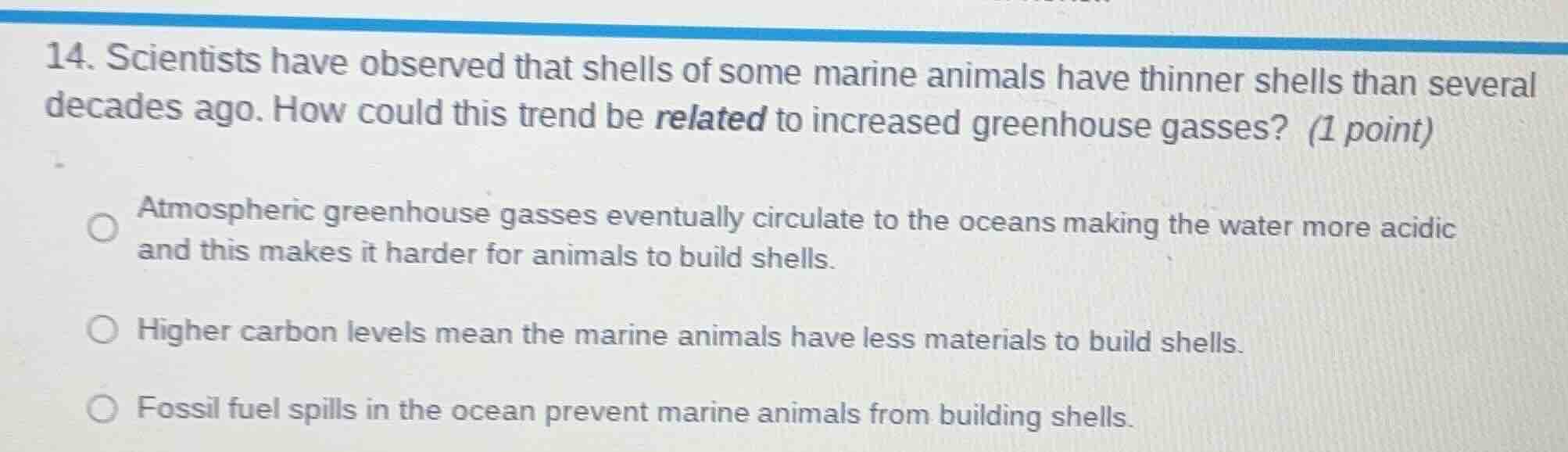
14. scientists have observed that shells of some marine animals have thinner shells than several decades ago. how could this trend be related to increased greenhouse gasses? (1 point)\n\natmospheric greenhouse gasses eventually circulate to the oceans making the water more acidic and this makes it harder for animals to build shells.\nhigher carbon levels mean the marine animals have less materials to build shells.\nfossil fuel spills in the ocean prevent marine animals from building shells.
Answer
Brief Explanations:
Increased greenhouse gases, specifically carbon dioxide ($CO_{2}$), are absorbed by the ocean from the atmosphere. This process leads to ocean acidification, where the $pH$ of the water decreases. The chemical reaction reduces the availability of carbonate ions ($CO_{3}^{2-}$), which marine calcifying organisms (like mollusks and corals) need to build and maintain their calcium carbonate shells. Consequently, the shells become thinner or more fragile over time.
Answer:
Atmospheric greenhouse gasses eventually circulate to the oceans making the water more acidic and this makes it harder for animals to build shells.