an antibiotic kills 60% of bacteria in a sample of 100,000 each day. the equation $p_1 = 100,000(0.4)^d$…
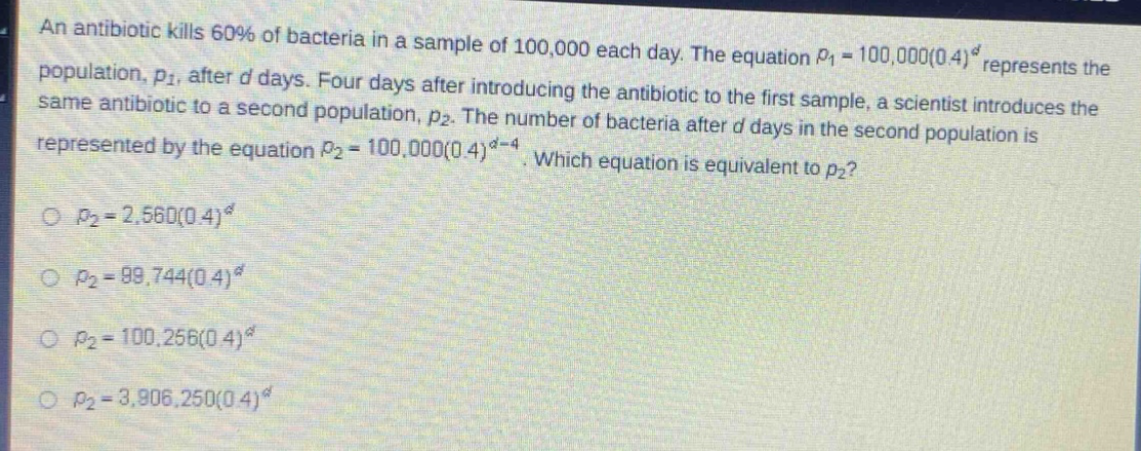
an antibiotic kills 60% of bacteria in a sample of 100,000 each day. the equation $p_1 = 100,000(0.4)^d$ represents the population, $p_1$, after $d$ days. four days after introducing the antibiotic to the first sample, a scientist introduces the same antibiotic to a second population, $p_2$. the number of bacteria after $d$ days in the second population is represented by the equation $p_2 = 100,000(0.4)^{d - 4}$. which equation is equivalent to $p_2$?\n$p_2 = 2,560(0.4)^d$\n$p_2 = 99,744(0.4)^d$\n$p_2 = 100,256(0.4)^d$\n$p_2 = 3,906,250(0.4)^d$
Answer
Answer:
$p_2 = 2,560(0.4)^d$
Explanation:
Step1: Expand $p_2$ formula
$p_2 = 100000(0.4)^{d - 4}=100000\times(0.4)^d\times(0.4)^{- 4}$
Step2: Calculate $(0.4)^{-4}$
$(0.4)^{-4}=\frac{1}{(0.4)^4}=\frac{1}{0.0256}=39.0625$
Step3: Multiply with 100000
$100000\times39.0625\times(0.4)^d = 2560\times(0.4)^d$