7. biology the initial number of bacteria in a culture is 12,000. the culture doubles each day. a. write an…
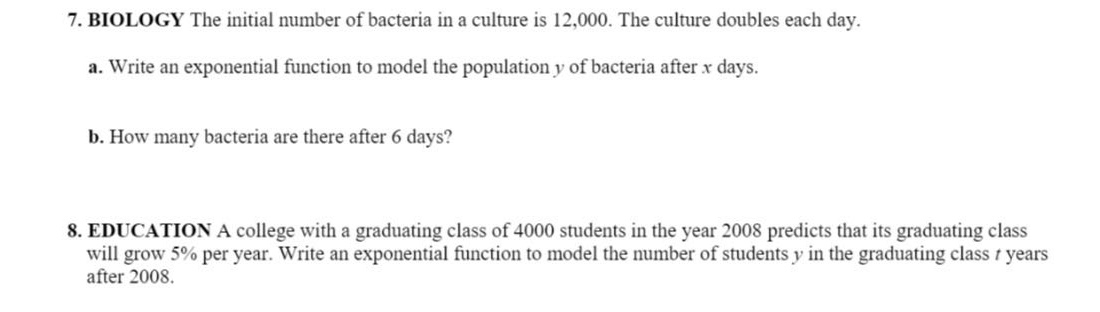
7. biology the initial number of bacteria in a culture is 12,000. the culture doubles each day. a. write an exponential function to model the population y of bacteria after x days. b. how many bacteria are there after 6 days? 8. education a college with a graduating class of 4000 students in the year 2008 predicts that its graduating class will grow 5% per year. write an exponential function to model the number of students y in the graduating class t years after 2008.
Answer
Answer:
a. $y = 12000\times2^{x}$ b. 768000
Explanation:
Step1: Identify the general form
The general form of an exponential - growth function is $y = a\times b^{x}$, where $a$ is the initial amount and $b$ is the growth factor.
Step2: Determine values for bacteria problem
For the bacteria problem, $a = 12000$ (initial number of bacteria) and $b = 2$ (doubles each day). So the function is $y = 12000\times2^{x}$.
Step3: Calculate number of bacteria after 6 days
Substitute $x = 6$ into the function $y = 12000\times2^{x}$. We have $y=12000\times2^{6}$. Since $2^{6}=64$, then $y = 12000\times64 = 768000$.
For the education problem:
Answer:
$y = 4000\times(1 + 0.05)^{t}=4000\times1.05^{t}$
Explanation:
Step1: Identify the general form
The general form of an exponential - growth function for a percentage increase is $y=a\times(1 + r)^{t}$, where $a$ is the initial amount, $r$ is the rate of growth as a decimal, and $t$ is the time.
Step2: Determine values for education problem
Here, $a = 4000$ (initial number of students in 2008), $r=0.05$ (5% growth rate as a decimal), and $t$ is the number of years after 2008. So the function is $y = 4000\times(1 + 0.05)^{t}=4000\times1.05^{t}$.