in a bird population, 50% of the individuals had white feathers, and 50% had colored feathers. over time, it…
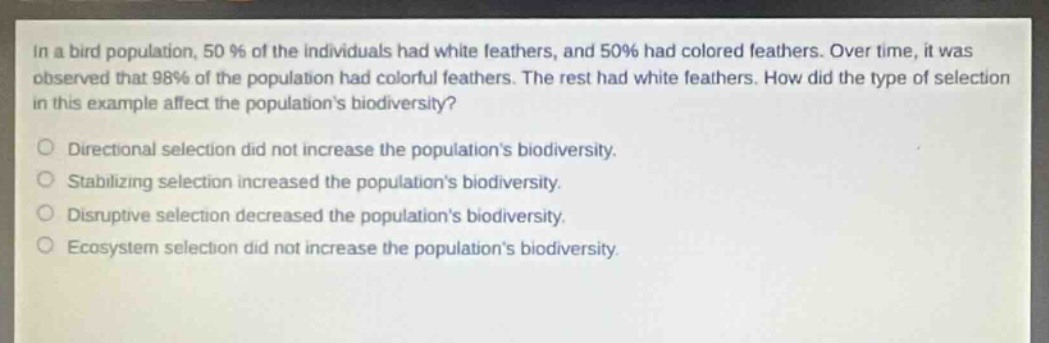
in a bird population, 50% of the individuals had white feathers, and 50% had colored feathers. over time, it was observed that 98% of the population had colorful feathers. the rest had white feathers. how did the type of selection in this example affect the populations biodiversity?\n\ndirectional selection did not increase the populations biodiversity.\nstabilizing selection increased the populations biodiversity.\ndisruptive selection decreased the populations biodiversity.\necosystem selection did not increase the populations biodiversity.
Answer
Brief Explanations:
In this case, the frequency of individuals with colored - feathers increased from 50% to 98% over time. Directional selection favors one extreme phenotype over others. Here, the phenotype of colored - feathers was favored. This reduces the proportion of the other phenotype (white - feathers), thus not increasing biodiversity. Stabilizing selection favors the average phenotype, disruptive selection favors both extremes, and "ecosystem selection" is not a standard type of selection in this context.
Answer:
Directional selection did not increase the population’s biodiversity.