cell division is an important process for both single-celled and multicellular organisms. when a healthy…
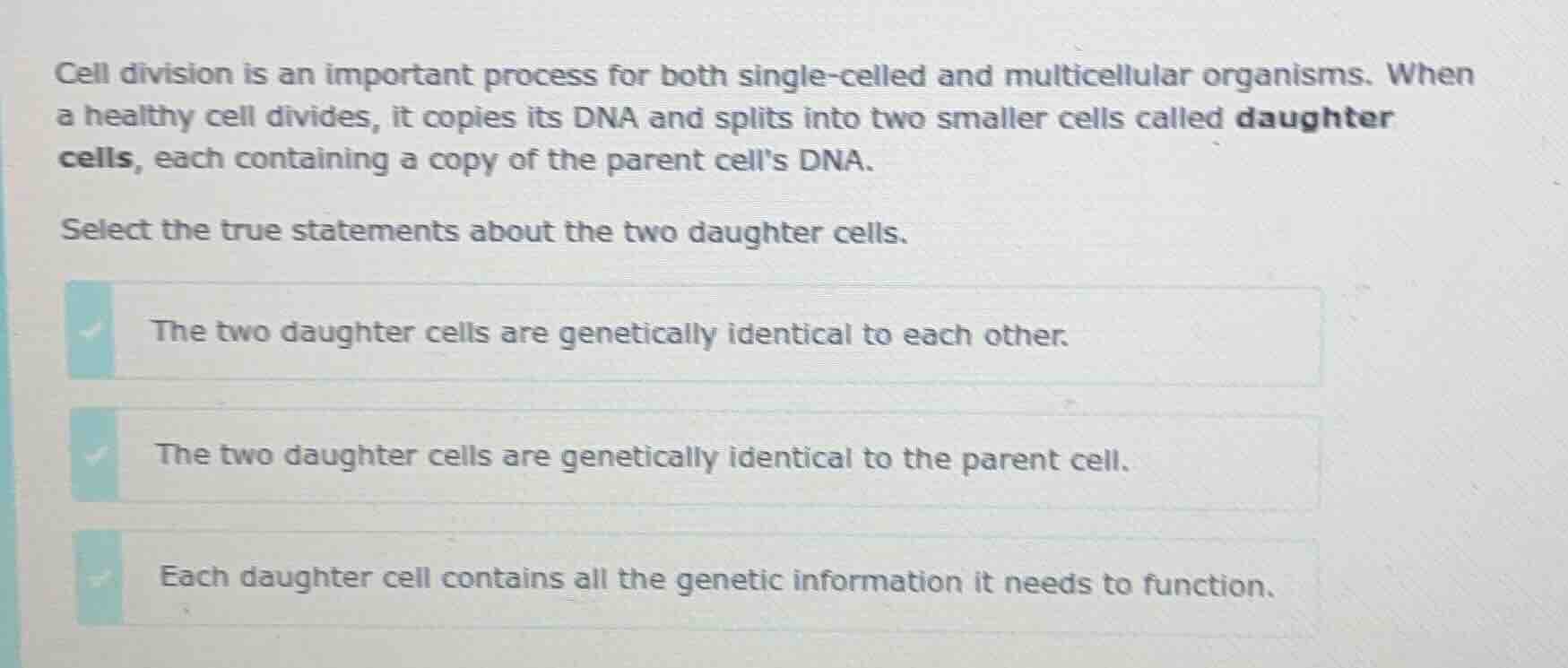
cell division is an important process for both single-celled and multicellular organisms. when a healthy cell divides, it copies its dna and splits into two smaller cells called daughter cells, each containing a copy of the parent cells dna.\nselect the true statements about the two daughter cells.\nthe two daughter cells are genetically identical to each other.\nthe two daughter cells are genetically identical to the parent cell.\neach daughter cell contains all the genetic information it needs to function.
Answer
Brief Explanations:
During healthy cell division (like mitosis, the common division for growth/repair), the parent cell's DNA is fully copied and evenly distributed to daughter cells. This means:
- Both daughter cells get identical copies of the parent's DNA, so they are genetically identical to each other.
- Since they receive exact copies of the parent cell's DNA, they are genetically identical to the parent cell.
- Each daughter cell receives a complete set of the organism's genetic material, which contains all the information needed to carry out its cellular functions.
Answer:
- The two daughter cells are genetically identical to each other.
- The two daughter cells are genetically identical to the parent cell.
- Each daughter cell contains all the genetic information it needs to function.