cells can be represented by a type of model called a cell diagram. scientists use cell diagrams to show the…
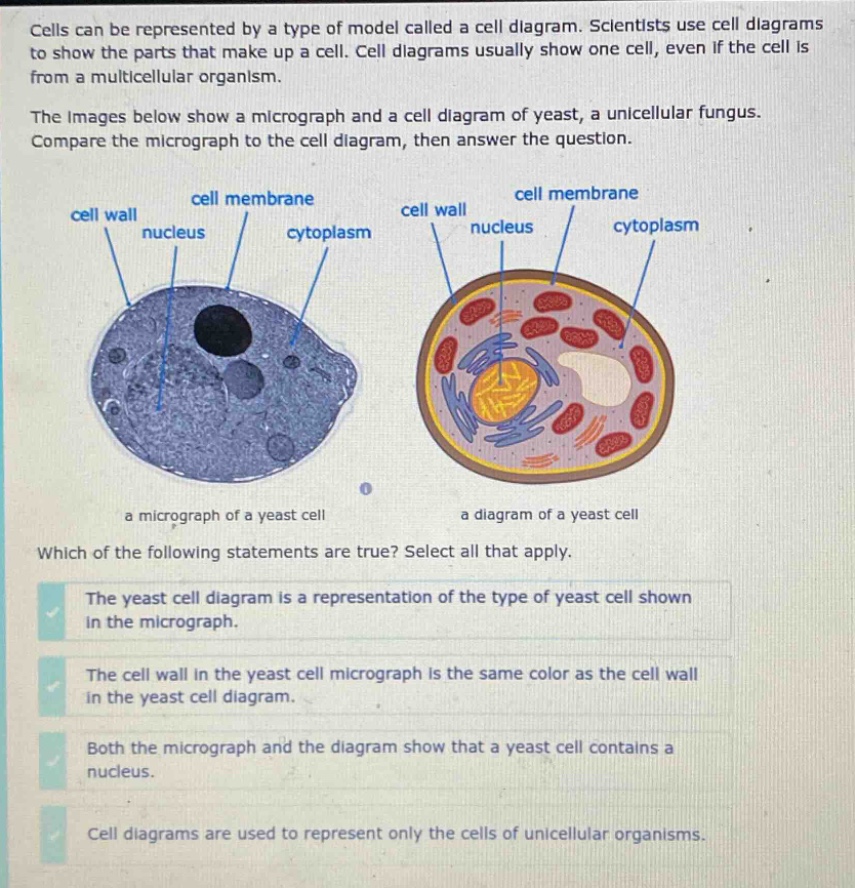
cells can be represented by a type of model called a cell diagram. scientists use cell diagrams to show the parts that make up a cell. cell diagrams usually show one cell, even if the cell is from a multicellular organism.\nthe images below show a micrograph and a cell diagram of yeast, a unicellular fungus. compare the micrograph to the cell diagram, then answer the question.\nwhich of the following statements are true? select all that apply.\nthe yeast cell diagram is a representation of the type of yeast cell shown in the micrograph.\nthe cell wall in the yeast cell micrograph is the same color as the cell wall in the yeast cell diagram.\nboth the micrograph and the diagram show that a yeast cell contains a nucleus.\ncell diagrams are used to represent only the cells of unicellular organisms.
Answer
Brief Explanations:
- The first statement is true as cell diagrams represent specific cell types, like the yeast cell in the micrograph.
- The second statement is false because micrographs may use stains or grayscale, while diagrams use arbitrary colors; color matching isn’t guaranteed.
- The third statement is true as both images explicitly label a nucleus.
- The fourth statement is false because the text states cell diagrams can show cells from multicellular organisms too.
Answer:
The yeast cell diagram is a representation of the type of yeast cell shown in the micrograph., Both the micrograph and the diagram show that a yeast cell contains a nucleus.