chris is a pediatrics nurse who conducts the first neonatal exam on newborn patients. he makes note of the…
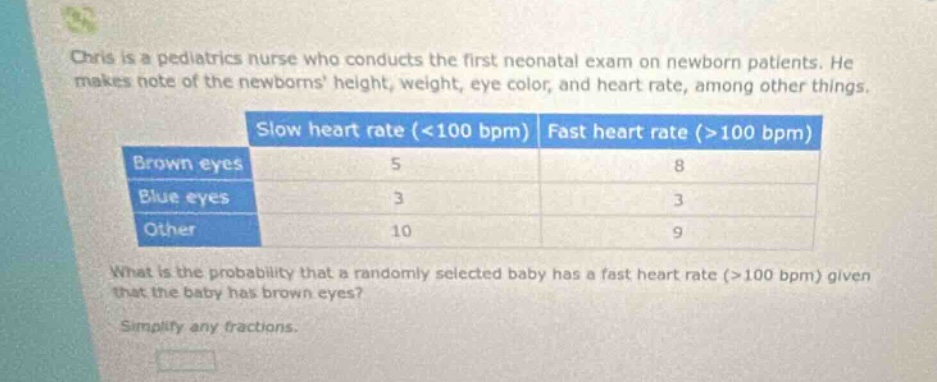
chris is a pediatrics nurse who conducts the first neonatal exam on newborn patients. he makes note of the newborns height, weight, eye color, and heart rate, among other things. slow heart rate (<100 bpm) fast heart rate (>100 bpm) brown eyes 5 8 blue eyes 3 3 other 10 9 what is the probability that a randomly selected baby has a fast heart rate (>100 bpm) given that the baby has brown eyes? simplify any fractions.
Answer
Explanation:
Step1: Definir fórmula de probabilidad condicional
La probabilidad condicional $P(A|B)=\frac{P(A\cap B)}{P(B)}$. En términos de frecuencias, $P(A|B)=\frac{n(A\cap B)}{n(B)}$, donde $A$ es el evento de tener un ritmo cardíaco rápido ($> 100$ bpm) y $B$ es el evento de tener ojos marrones.
Step2: Encontrar $n(A\cap B)$ y $n(B)$
$n(A\cap B)$ es el número de bebés con ojos marrones y ritmo cardíaco rápido, que es 8. $n(B)$ es el número total de bebés con ojos marrones, que es $5 + 8=13$.
Step3: Calcular la probabilidad condicional
$P(A|B)=\frac{n(A\cap B)}{n(B)}=\frac{8}{13}$
Answer:
$\frac{8}{13}$