conlan wants to answer the question, \does phosphorus affect tomato fruit production?\ which statement…
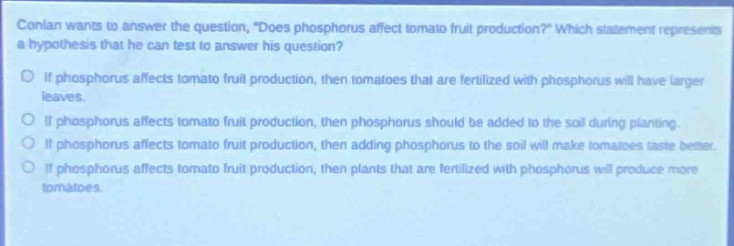
conlan wants to answer the question, \does phosphorus affect tomato fruit production?\ which statement represents a hypothesis that he can test to answer his question?\nif phosphorus affects tomato fruit production, then tomatoes that are fertilized with phosphorus will have larger leaves.\nif phosphorus affects tomato fruit production, then phosphorus should be added to the soil during planting.\nif phosphorus affects tomato fruit production, then adding phosphorus to the soil will make tomatoes taste better.\nif phosphorus affects tomato fruit production, then plants that are fertilized with phosphorus will produce more tomatoes.
Answer
Brief Explanations:
A hypothesis is a test - able prediction. The question is about the effect of phosphorus on tomato fruit production. The first option is about leaf size, not fruit production. The second option is about when to add phosphorus, not the effect on fruit production. The third option is about taste, not the amount of fruit production. The fourth option directly relates the addition of phosphorus to the production of more tomatoes, which is test - able and relevant to the question.
Answer:
If phosphorus affects tomato fruit production, then plants that are fertilized with phosphorus will produce more tomatoes.