consider the following data.\nrates for cheetah population from 2011 to 2012\ncause of change 2011…
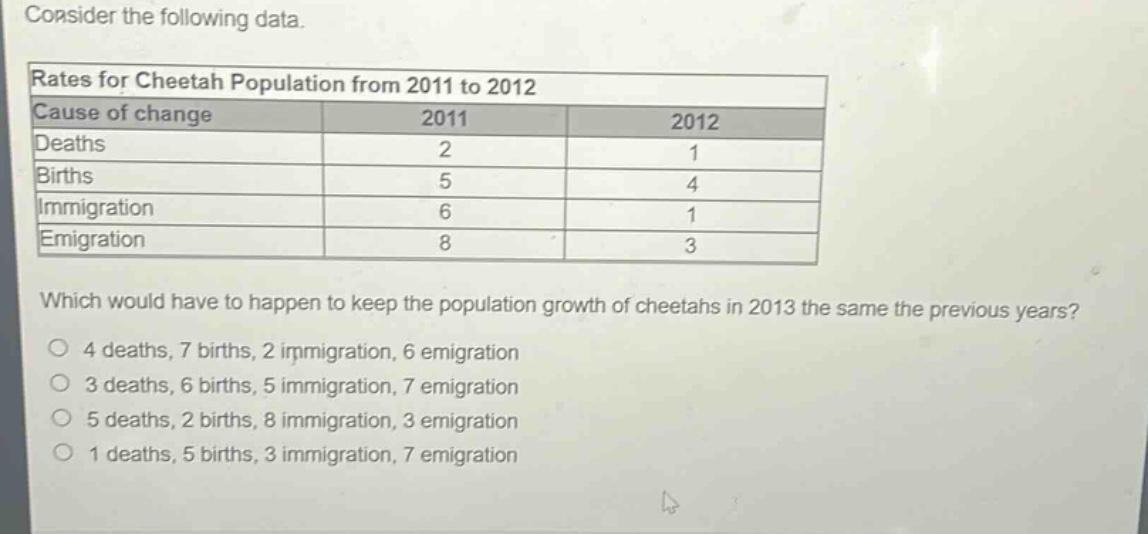
consider the following data.\nrates for cheetah population from 2011 to 2012\ncause of change 2011 2012\ndeaths 2 1\nbirths 5 4\nimmigration 6 1\nemigration 8 3\nwhich would have to happen to keep the population growth of cheetahs in 2013 the same the previous years?\n4 deaths, 7 births, 2 immigration, 6 emigration\n3 deaths, 6 births, 5 immigration, 7 emigration\n5 deaths, 2 births, 8 immigration, 3 emigration\n1 deaths, 5 births, 3 immigration, 7 emigration
Answer
Answer:
B. 3 deaths, 6 births, 5 immigration, 7 emigration
Explanation:
Step1: Calculate population change in 2011
Population change in 2011 = Births + Immigration - Deaths - Emigration = $5 + 6-2 - 8=1$
Step2: Calculate population change in 2012
Population change in 2012 = Births + Immigration - Deaths - Emigration = $4 + 1-1 - 3=1$
Step3: Calculate population change for each option in 2013
Option A:
Population change = $7 + 2-4 - 6=-1$
Option B:
Population change = $6 + 5-3 - 7=1$
Option C:
Population change = $2 + 8-5 - 3=2$
Option D:
Population change = $5 + 3-1 - 7=0$ Since the population change in 2011 and 2012 was 1, option B with a population - change of 1 in 2013 will keep the population growth the same as the previous years.