a cross is performed between a bird that is homozygous for red feathers and a bird that is homozygous for…
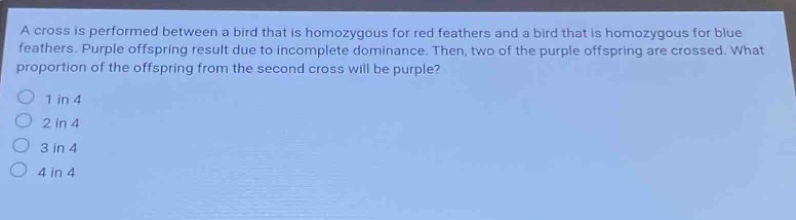
a cross is performed between a bird that is homozygous for red feathers and a bird that is homozygous for blue feathers. purple offspring result due to incomplete dominance. then, two of the purple offspring are crossed. what proportion of the offspring from the second cross will be purple? 1 in 4 2 in 4 3 in 4 4 in 4
Answer
Explanation:
Step1: Define alleles
Let $R$ represent the allele for red feathers and $B$ represent the allele for blue feathers. The homozygous red - feathered bird has genotype $RR$, the homozygous blue - feathered bird has genotype $BB$, and the purple offspring (due to incomplete dominance) have genotype $RB$.
Step2: Set up the Punnett - square for the second cross
When two purple ($RB$) birds are crossed, the possible gametes from each parent are $R$ and $B$. The Punnett - square has the following combinations:
| $R$ | $B$ | |
|---|---|---|
| $R$ | $RR$ | $RB$ |
| $B$ | $RB$ | $BB$ |
Step3: Determine the proportion of purple offspring
From the Punnett - square, the genotypes are $1RR:2RB:1BB$. Since the purple phenotype is associated with the $RB$ genotype, the proportion of purple offspring is $\frac{2}{4}$ or 2 in 4.
Answer:
2 in 4