the diagram shows the fossils of organisms (a, b, c, and d) deposited in rock layers in four different areas…
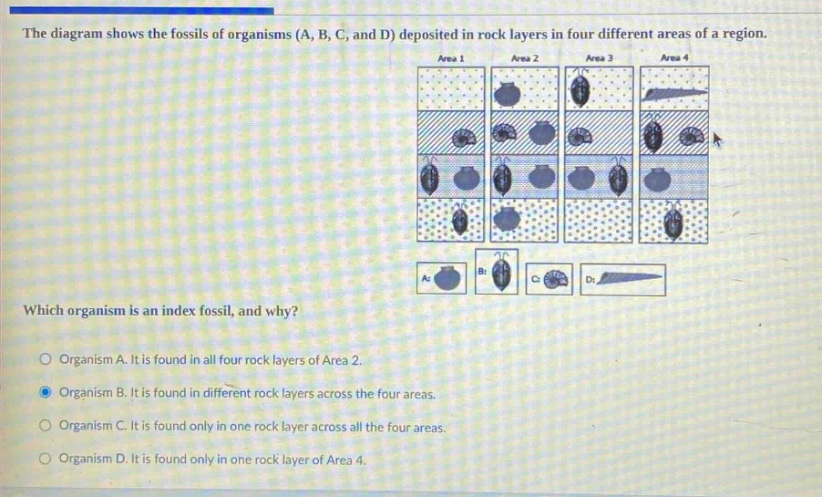
the diagram shows the fossils of organisms (a, b, c, and d) deposited in rock layers in four different areas of a region. which organism is an index fossil, and why? organism a. it is found in all four rock layers of area 2. organism b. it is found in different rock layers across the four areas. organism c. it is found only in one rock layer across all the four areas. organism d. it is found only in one rock layer of area 4.
Answer
Brief Explanations:
Index fossils are widespread geographically and found in a limited time - range. Organism B is found in different rock layers across the four areas, which meets the criteria of being widespread. Other organisms either have limited distribution (like Organism D in only one layer of one area) or are not widespread across areas (like Organism A in only Area 2). Organism C being in only one layer across all areas may not be as indicative of a time - interval as an organism found in multiple layers across areas.
Answer:
Organism B. It is found in different rock layers across the four areas.