a dietician asks a patient about the food that the patient eats and makes the table below to summarize the…
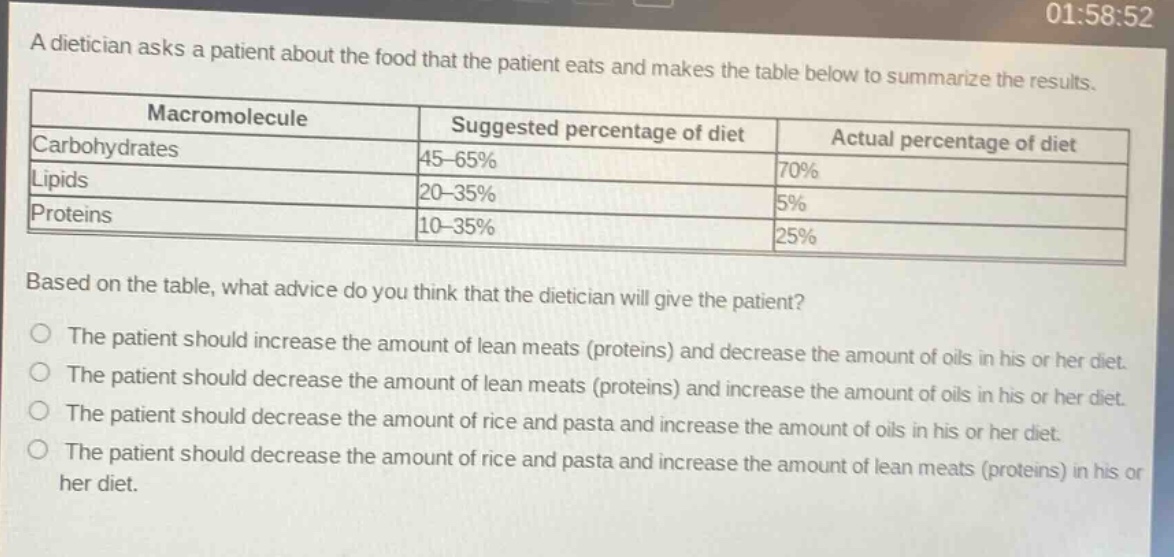
a dietician asks a patient about the food that the patient eats and makes the table below to summarize the results.\n| macromolecule | suggested percentage of diet | actual percentage of diet |\n|--|--|--|\n| carbohydrates | 45 - 65% | 70% |\n| lipids | 20 - 35% | 5% |\n| proteins | 10 - 35% | 25% |\nbased on the table, what advice do you think that the dietician will give the patient?\no the patient should increase the amount of lean meats (proteins) and decrease the amount of oils in his or her diet.\no the patient should decrease the amount of lean meats (proteins) and increase the amount of oils in his or her diet.\no the patient should decrease the amount of rice and pasta and increase the amount of oils in his or her diet.\no the patient should decrease the amount of rice and pasta and increase the amount of lean meats (proteins) in his or her diet.
Answer
Brief Explanations:
The provided table indicates the patient's actual dietary intake compared to suggested percentages for key macromolecules.
- Carbohydrates: The patient's actual intake is 70%, which is higher than the suggested range of 45-65%. This suggests a need to reduce carbohydrate consumption. Rice and pasta are common sources of carbohydrates.
- Lipids: The patient's actual intake is 5%, which is significantly lower than the suggested range of 20-35%. This indicates a need to increase lipid consumption. Oils are a common source of lipids.
- Proteins: The patient's actual intake is 25%, which falls within the suggested range of 10-35%. Therefore, protein intake is currently adequate and not the primary concern for adjustment.
Based on these observations, the dietician would likely advise the patient to decrease their carbohydrate intake and increase their lipid intake.
Answer:
The patient should decrease the amount of rice and pasta and increase the amount of oils in his or her diet.