what is the end result of meiosis?\nfour identical daughter cells\nfour different daughter cells\ntwo…
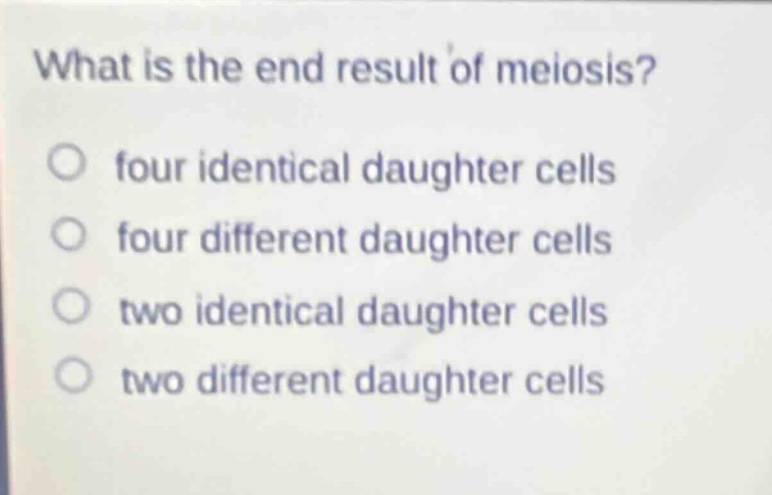
what is the end result of meiosis?\nfour identical daughter cells\nfour different daughter cells\ntwo identical daughter cells\ntwo different daughter cells
Answer
Brief Explanations:
Meiosis is a type of cell division that occurs in sexually - reproducing organisms. It involves two rounds of division (meiosis I and meiosis II). During meiosis I, homologous chromosomes pair up, exchange genetic material (crossing - over), and then separate. This leads to genetic variation. In meiosis II, sister chromatids separate. The starting cell is diploid (has two sets of chromosomes), and after meiosis, four haploid (has one set of chromosomes) daughter cells are produced. Since crossing - over occurs during prophase I of meiosis I, these four daughter cells are genetically different from each other and from the parent cell. In contrast, mitosis results in two identical daughter cells (in the case of somatic cells in animals or vegetative cells in plants).
Answer:
four different daughter cells