an environmental group is tracking a fast - growing algaes coverage on a nearby pond. when the group first…
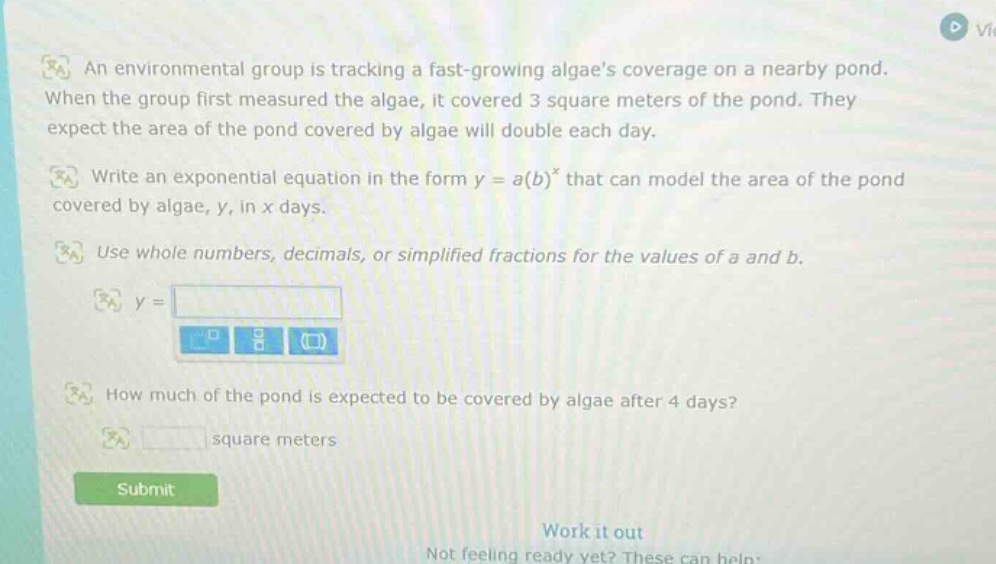
an environmental group is tracking a fast - growing algaes coverage on a nearby pond. when the group first measured the algae, it covered 3 square meters of the pond. they expect the area of the pond covered by algae will double each day. write an exponential equation in the form y = a(b)^x that can model the area of the pond covered by algae, y, in x days. use whole numbers, decimals, or simplified fractions for the values of a and b. y = how much of the pond is expected to be covered by algae after 4 days? square meters
Answer
Explanation:
Step1: Identify the initial - value
The initial area of the algae is 3 square meters, so $a = 3$.
Step2: Identify the growth - factor
The area doubles each day, so the growth - factor $b = 2$. The exponential equation is $y=a(b)^x$, substituting $a = 3$ and $b = 2$ we get $y = 3(2)^x$.
Step3: Calculate the area after 4 days
Substitute $x = 4$ into the equation $y = 3(2)^x$. $y=3\times2^4$. First, calculate $2^4=16$. Then, $y = 3\times16=48$.
Answer:
$y = 3(2)^x$ 48