the estimated number of organisms in a population after t days is shown in the table below.\n| t days |…
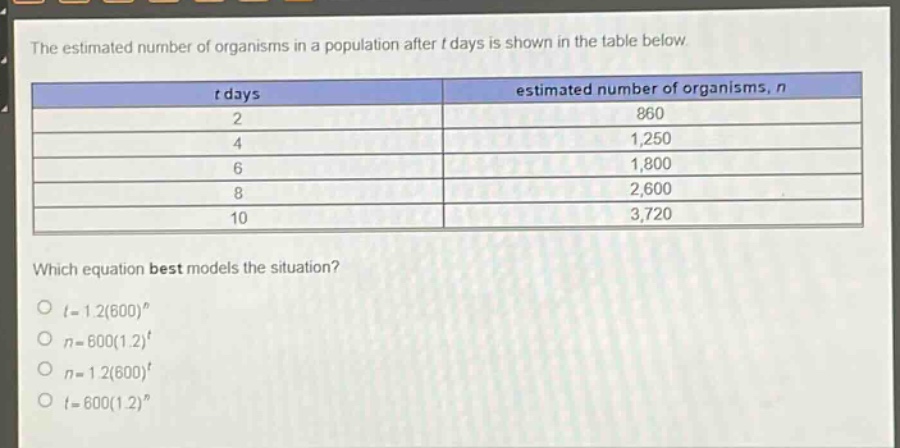
the estimated number of organisms in a population after t days is shown in the table below.\n| t days | estimated number of organisms, n |\n| ---- | ---- |\n| 2 | 860 |\n| 4 | 1,250 |\n| 6 | 1,800 |\n| 8 | 2,600 |\n| 10 | 3,720 |\nwhich equation best models the situation?\n$t = 1.2(600)^n$\n$n = 600(1.2)^t$\n$n = 1.2(600)^t$\n$t = 600(1.2)^n$
Answer
Explanation:
Step1: Recall exponential - growth formula
The general form of an exponential - growth model is $n = a(b)^t$, where $n$ is the quantity at time $t$, $a$ is the initial quantity, and $b$ is the growth factor.
Step2: Test the first data - point $(t = 2,n = 860)$
Let's test each option:
- Option 1: $t = 1.2(800)^n$ is not in the correct form of an exponential model for population growth where $n$ should be a function of $t$.
- Option 2: For $n = 600(1.2)^t$, when $t = 2$, $n=600\times(1.2)^2=600\times1.44 = 864$, which is close to 860.
- Option 3: For $n = 1.2(600)^t$, when $t = 2$, $n = 1.2\times600^2=1.2\times360000=432000$, which is not close to 860.
- Option 4: $t = 600(1.2)^n$ is not in the correct form of an exponential model for population growth where $n$ should be a function of $t$.
Answer:
$n = 600(1.2)^t$