after evaluating his colleague’s claim about plant pathogens being carried in african dust clouds, the…
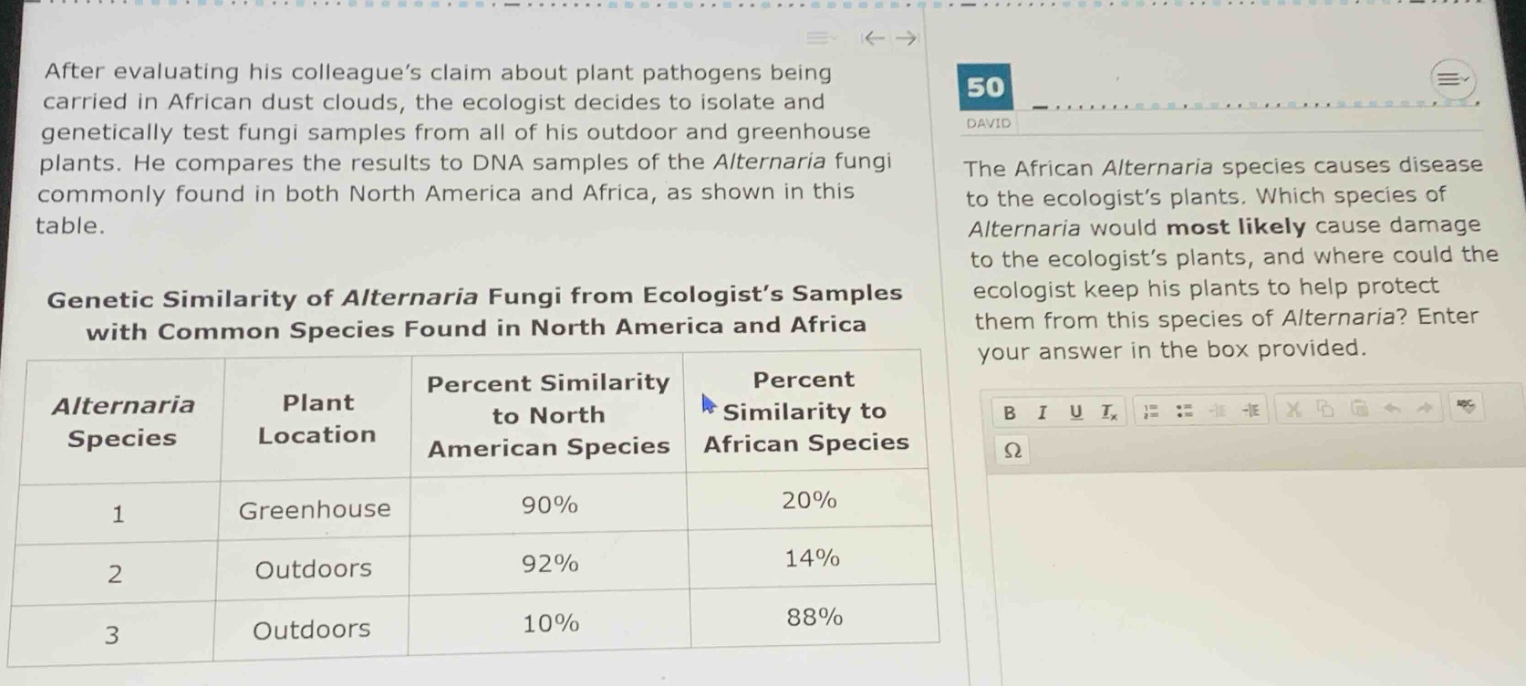
after evaluating his colleague’s claim about plant pathogens being carried in african dust clouds, the ecologist decides to isolate and genetically test fungi samples from all of his outdoor and greenhouse plants. he compares the results to dna samples of the alternaria fungi commonly found in both north america and africa, as shown in this table.\ngenetic similarity of alternaria fungi from ecologist’s samples with common species found in north america and africa\n| alternaria species | plant location | percent similarity to north american species | percent similarity to african species |\n| ---- | ---- | ---- | ---- |\n| 1 | greenhouse | 90% | 20% |\n| 2 | outdoors | 92% | 14% |\n| 3 | outdoors | 10% | 88% |\nthe african alternaria species causes disease to the ecologist’s plants. which species of alternaria would most likely cause damage to the ecologist’s plants, and where could the ecologist keep his plants to help protect them from this species of alternaria? enter your answer in the box provided.
Answer
Explanation:
Step1: Identify the key - causing species
The African Alternaria species causes disease. We need to find the sample with high similarity to the African species.
Step2: Analyze the table
Sample 3 has 88% similarity to the African species, which is the highest among the samples.
Step3: Determine the protective measure
To protect the plants from the African - causing species, keep them away from areas where African dust clouds may reach. Since the African species is associated with African dust clouds, keeping the plants indoors (like in a greenhouse) can help as it reduces exposure to outdoor dust.
Answer:
The species of Alternaria most likely to cause damage is Species 3. The ecologist could keep his plants in a greenhouse to help protect them.