which evolutionary adaptations helped plants succeed and spread on land?\no vascular tissue and seeds\no…
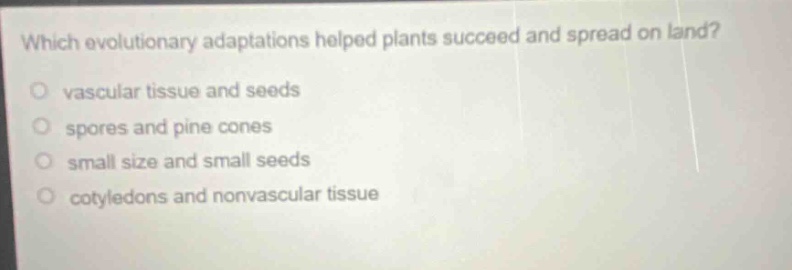
which evolutionary adaptations helped plants succeed and spread on land?\no vascular tissue and seeds\no spores and pine cones\no small size and small seeds\no cotyledons and nonvascular tissue
Answer
Brief Explanations:
Vascular tissue allows for efficient transport of water, nutrients, and photosynthetic products, enabling plants to grow larger and in diverse habitats. Seeds protect the embryo and provide a supply of nutrients, increasing the chances of successful germination and plant establishment on land. Spores are less protective than seeds. Small - size and small seeds don't directly relate to the key adaptations for land - success. Nonvascular tissue is less efficient for land plants compared to vascular tissue, and cotyledons are part of seeds but not the main adaptation for land spread on their own.
Answer:
vascular tissue and seeds