a florist wants to determine if a new additive helps extend the life of cut flowers longer than the original…
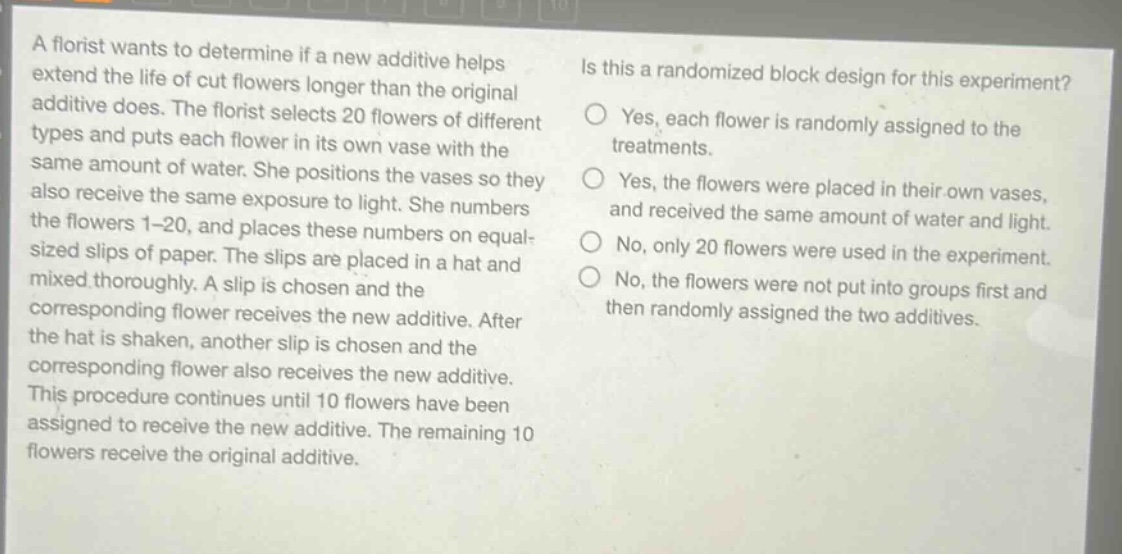
a florist wants to determine if a new additive helps extend the life of cut flowers longer than the original additive does. the florist selects 20 flowers of different types and puts each flower in its own vase with the same amount of water. she positions the vases so they also receive the same exposure to light. she numbers the flowers 1 - 20, and places these numbers on equal - sized slips of paper. the slips are placed in a hat and mixed thoroughly. a slip is chosen and the corresponding flower receives the new additive. after the hat is shaken, another slip is chosen and the corresponding flower also receives the new additive. this procedure continues until 10 flowers have been assigned to receive the new additive. the remaining 10 flowers receive the original additive. is this a randomized block design for this experiment? yes, each flower is randomly assigned to the treatments. yes, the flowers were placed in their own vases, and received the same amount of water and light. no, only 20 flowers were used in the experiment. no, the flowers were not put into groups first and then randomly assigned the two additives.
Answer
Brief Explanations:
In a randomized - block design, subjects are first grouped into blocks based on some characteristic (e.g., flower type here), and then treatments are randomly assigned within each block. In this experiment, the flowers were not grouped first into blocks based on flower type before random assignment of the two additives. Instead, all 20 flowers were simply randomly assigned to the two treatments without pre - forming blocks.
Answer:
No, the flowers were not put into groups first and then randomly assigned the two additives.