the flowchart below shows the three generations of a cross between a pea plant that has yellow pods and a…
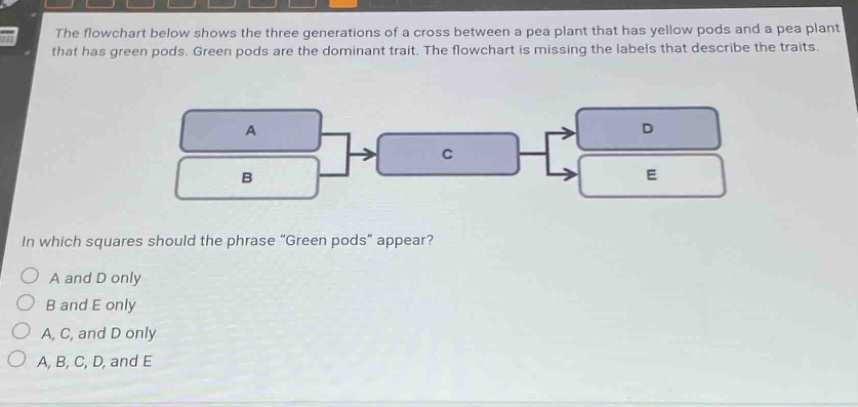
the flowchart below shows the three generations of a cross between a pea plant that has yellow pods and a pea plant that has green pods. green pods are the dominant trait. the flowchart is missing the labels that describe the traits. in which squares should the phrase \green pods\ appear? a and d only b and e only a, c, and d only a, b, c, d, and e
Answer
Explanation:
Step1: Understand dominant - recessive traits
Green pods are dominant. Let's assume the allele for green pods is G and for yellow pods is g. A plant with yellow pods has a genotype of gg. A plant with green pods can have genotypes GG or Gg.
Step2: First - generation cross
When a yellow - pod plant (gg) is crossed with a green - pod plant (either GG or Gg), if the green - pod plant is GG, all offspring (C) will be Gg (green pods). If the green - pod plant is Gg, the offspring (C) will have genotypes Gg (green pods) and gg (yellow pods) in a 1:1 ratio. But since the flowchart shows a single intermediate generation (C), we assume the green - pod parent is GG. So, C is Gg (green pods).
Step3: Second - generation cross
When C (Gg) is self - crossed, the offspring genotypes are GG:Gg:gg in a 1:2:1 ratio. The phenotypes are green pods (GG and Gg) and yellow pods (gg). So, D (which is a green - pod offspring) can be GG or Gg. Since green is dominant, the parents of the first cross (A and B), one of them (the green - pod parent) has green pods, the first - generation offspring (C) has green pods (because of the dominance of the green trait), and some of the second - generation offspring (D) have green pods.
Answer:
A, C, and D only