a fossil of a new primate species is discovered. scientists find evidence that members of this species…
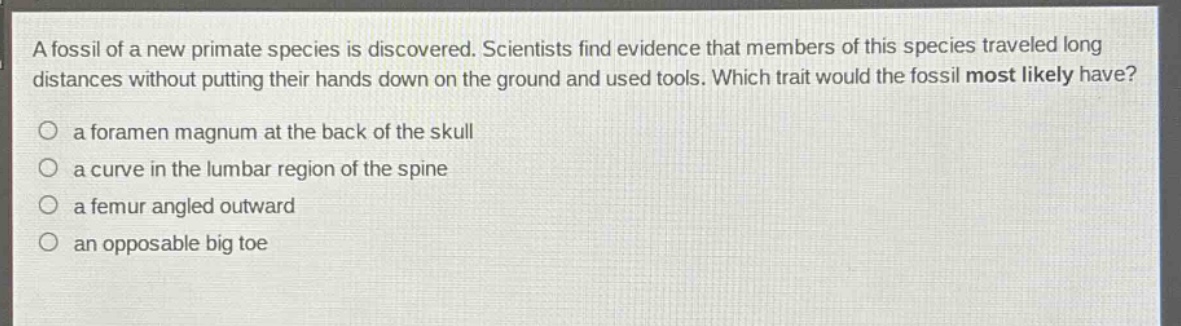
a fossil of a new primate species is discovered. scientists find evidence that members of this species traveled long distances without putting their hands down on the ground and used tools. which trait would the fossil most likely have?\no a foramen magnum at the back of the skull\no a curve in the lumbar region of the spine\no a femur angled outward\no an opposable big toe
Answer
Answer:
B. a curve in the lumbar region of the spine
Explanation:
Step1: Analyze each option
- A. Foramen magnum at the back of the skull: In non - bipedal primates (like quadrupeds), the foramen magnum is at the back. But for a species that travels long distances without putting hands down (bipedal), the foramen magnum is more centrally located. So this is incorrect.
- B. Curve in the lumbar region of the spine: A curve in the lumbar region (lordosis) helps in maintaining balance during bipedal locomotion. Since the species travels long distances bipedally, this trait is likely.
- C. Femur angled outward: In bipedal primates (hominins), the femur is angled inward ( valgus knee) to bring the knees under the body for efficient bipedal walking. So this is incorrect.
- D. Opposable big toe: Opposable big toe is useful for grasping (arboreal locomotion). For a bipedal species that travels long distances on the ground, an opposable big toe is not typical (non - opposable big toe is more common in bipedal hominins for better bipedal locomotion). So this is incorrect.