after few generations\nwhich is the most likely explanation for the change?\nthe beetle population moved to…
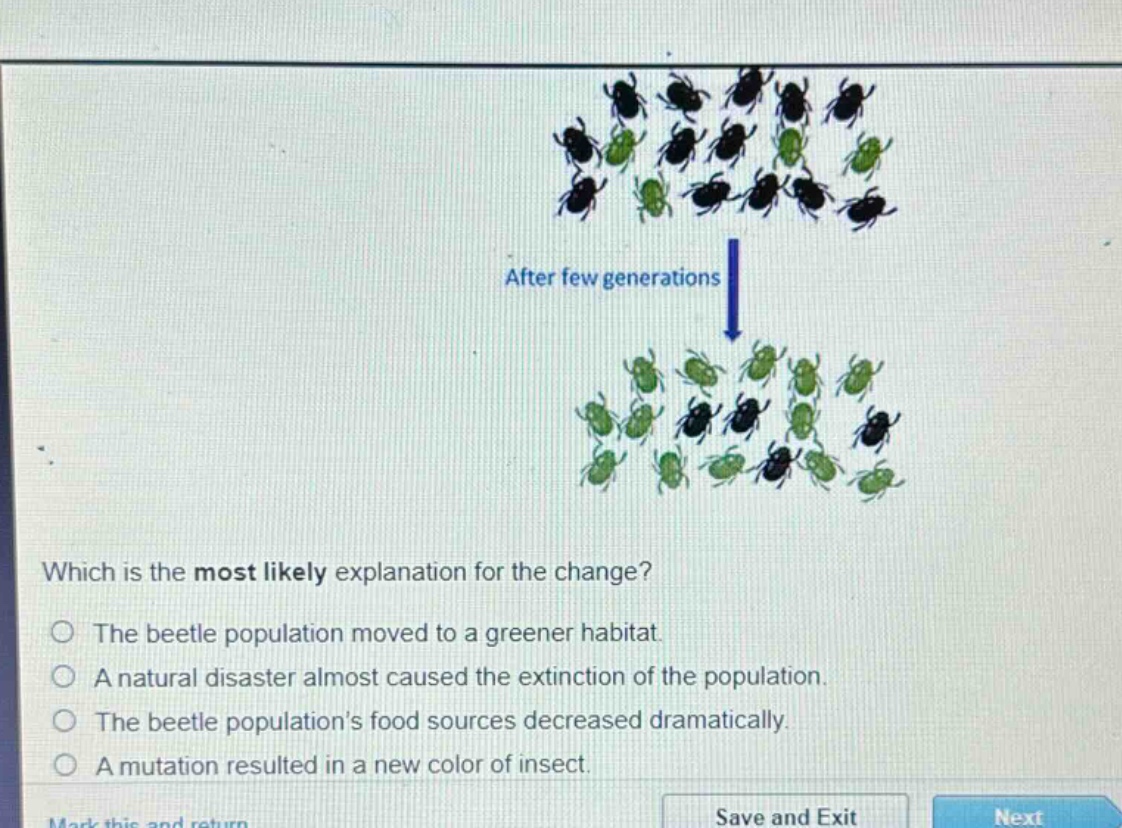
after few generations\nwhich is the most likely explanation for the change?\nthe beetle population moved to a greener habitat.\na natural disaster almost caused the extinction of the population.\nthe beetle populations food sources decreased dramatically.\na mutation resulted in a new color of insect.
Answer
Brief Explanations:
The image depicts a change in a beetle population over a few generations. Initially, black beetles are more numerous than green beetles. After a few generations, green beetles become more numerous than black beetles. This shift in the frequency of traits within a population suggests an evolutionary process, most likely natural selection.
Let's analyze the given options:
- The beetle population moved to a greener habitat: If the beetles moved to an environment with more green vegetation, the green beetles would be better camouflaged from predators. This would give them a higher survival rate and, consequently, more opportunities to reproduce. Over generations, this would lead to an increase in the proportion of green beetles and a decrease in the proportion of black beetles, which is consistent with the image.
- A natural disaster almost caused the extinction of the population: While a natural disaster could drastically reduce the population size, it would not necessarily cause a shift in the color ratio unless the disaster selectively targeted one color over the other. The image primarily shows a change in proportions rather than just a near-extinction event.
- The beetle population's food sources decreased dramatically: A decrease in food sources would likely impact the entire population, potentially leading to a decline in numbers. However, it doesn't directly explain why green beetles would become more prevalent unless the food source itself or access to it was linked to beetle color, which is not implied.
- A mutation resulted in a new color of insect: The image shows that both green and black beetles were present in the initial population. The change observed is an increase in the frequency of an existing color (green), not the appearance of a new color due to a recent mutation. While mutations are the ultimate source of variation, the shift in proportions over a few generations is typically driven by selection acting on existing variation.
Considering these points, the most likely explanation is that a change in the environment (or the population's location) made the green coloration more advantageous, leading to natural selection favoring green beetles.
Answer:
The beetle population moved to a greener habitat.