a graduate student is studying bacteria known to have a growth rate of 7% per day. if the population of a…
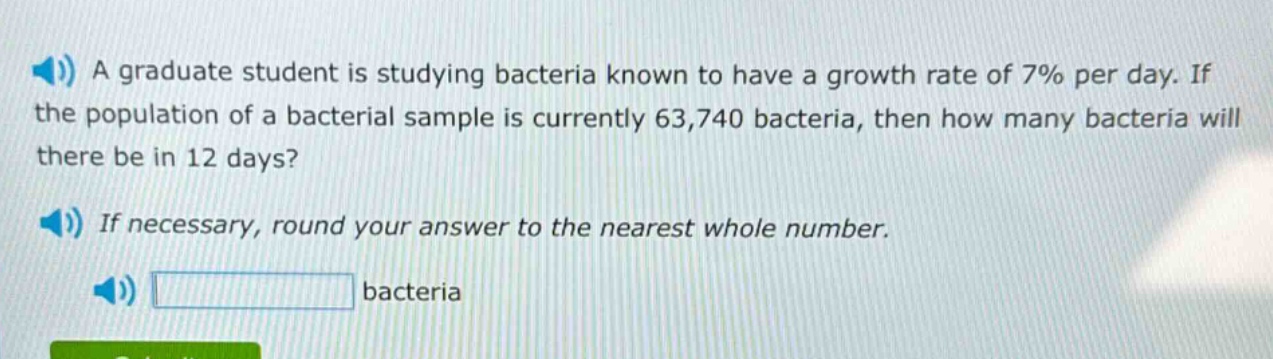
a graduate student is studying bacteria known to have a growth rate of 7% per day. if the population of a bacterial sample is currently 63,740 bacteria, then how many bacteria will there be in 12 days? if necessary, round your answer to the nearest whole number. bacteria
Answer
Explanation:
Step1: Identify the formula
The formula for exponential - growth is $A = P(1 + r)^t$, where $P$ is the initial amount, $r$ is the growth rate as a decimal, and $t$ is the time.
Step2: Convert the growth rate to a decimal
The growth rate $r = 7%=0.07$, $P = 63740$, and $t = 12$.
Step3: Substitute the values into the formula
$A=63740\times(1 + 0.07)^{12}$. First, calculate $(1 + 0.07)^{12}$. Using the formula $a^n=e^{n\ln(a)}$, we have $(1.07)^{12}=e^{12\ln(1.07)}$. $\ln(1.07)\approx0.06766$, so $12\ln(1.07)\approx12\times0.06766 = 0.81192$. $e^{0.81192}\approx2.25219$. Then $A = 63740\times2.25219$. $A=63740\times2.25219 = 143554.6906$.
Step4: Round the answer
Rounding $143554.6906$ to the nearest whole number gives $143555$.
Answer:
$143555$