1. what has to happen for a fossil to form?\n2. where are the oldest layers of sedimentary rock usually…
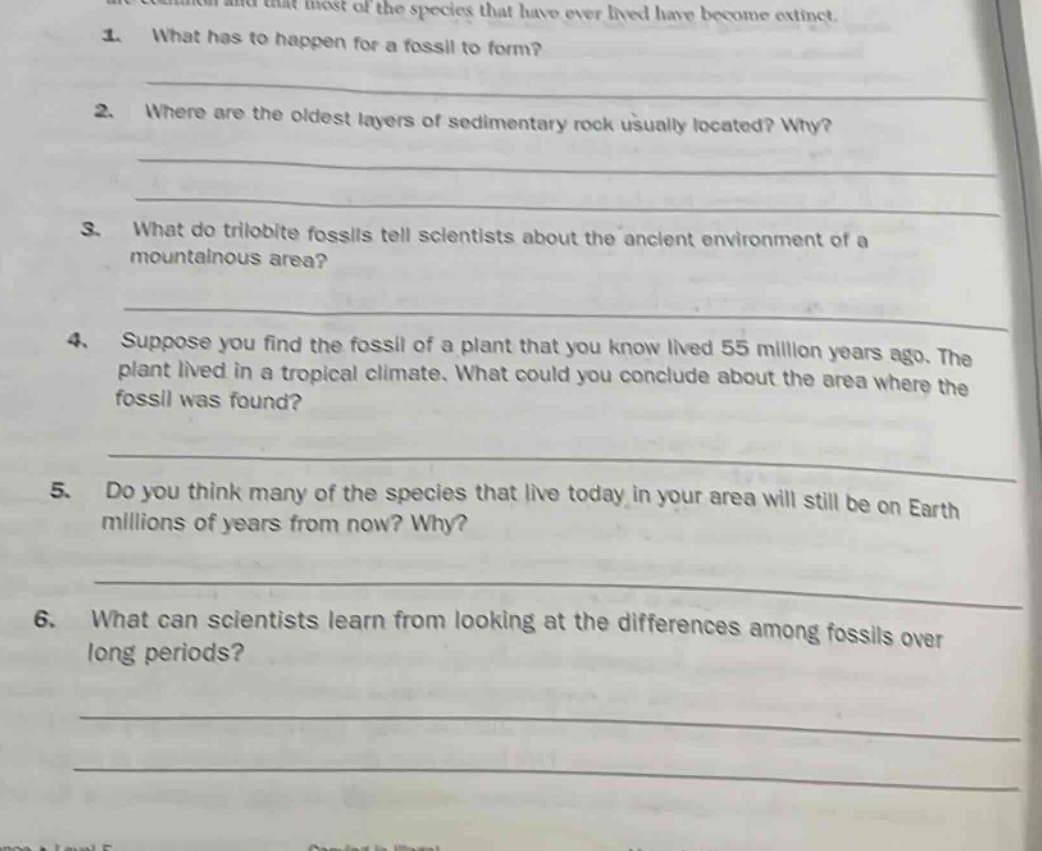
1. what has to happen for a fossil to form?\n2. where are the oldest layers of sedimentary rock usually located? why?\n3. what do trilobite fossils tell scientists about the ancient environment of a mountainous area?\n4. suppose you find the fossil of a plant that you know lived 55 million years ago. the plant lived in a tropical climate. what could you conclude about the area where the fossil was found?\n5. do you think many of the species that live today in your area will still be on earth millions of years from now? why?\n6. what can scientists learn from looking at the differences among fossils over long periods?
Answer
Brief Explanations:
- For a fossil to form, an organism must be quickly buried after death to prevent decomposition. Sediment then accumulates over time, and minerals replace the organic material.
- The oldest layers of sedimentary rock are usually located at the bottom. This is because sedimentary rock forms in layers over time, with new layers being deposited on top of older ones.
- Trilobite fossils are marine - dwelling organisms. Their presence in a mountainous area indicates that the area was once covered by water.
- If a 55 - million - year - old plant fossil that lived in a tropical climate is found, it suggests that the area where the fossil was found had a tropical climate at that time.
- It is uncertain if many of the species in an area today will still be on Earth millions of years from now. Factors like climate change, habitat loss, and evolution can cause species to go extinct or evolve into new species.
- By looking at the differences among fossils over long periods, scientists can learn about the process of evolution, changes in climate, and the history of life on Earth.
Answer:
- An organism must be quickly buried after death and then sediment accumulates and minerals replace organic material.
- At the bottom; sedimentary rock forms with new layers on top of older ones.
- The mountainous area was once covered by water.
- The area had a tropical climate 55 million years ago.
- Uncertain; due to factors like climate change, habitat loss, and evolution.
- About the process of evolution, changes in climate, and the history of life on Earth.