6. in horses, coat color black (b) is dominant over chestnut (b). the trotting gait is dominant (t) over the…
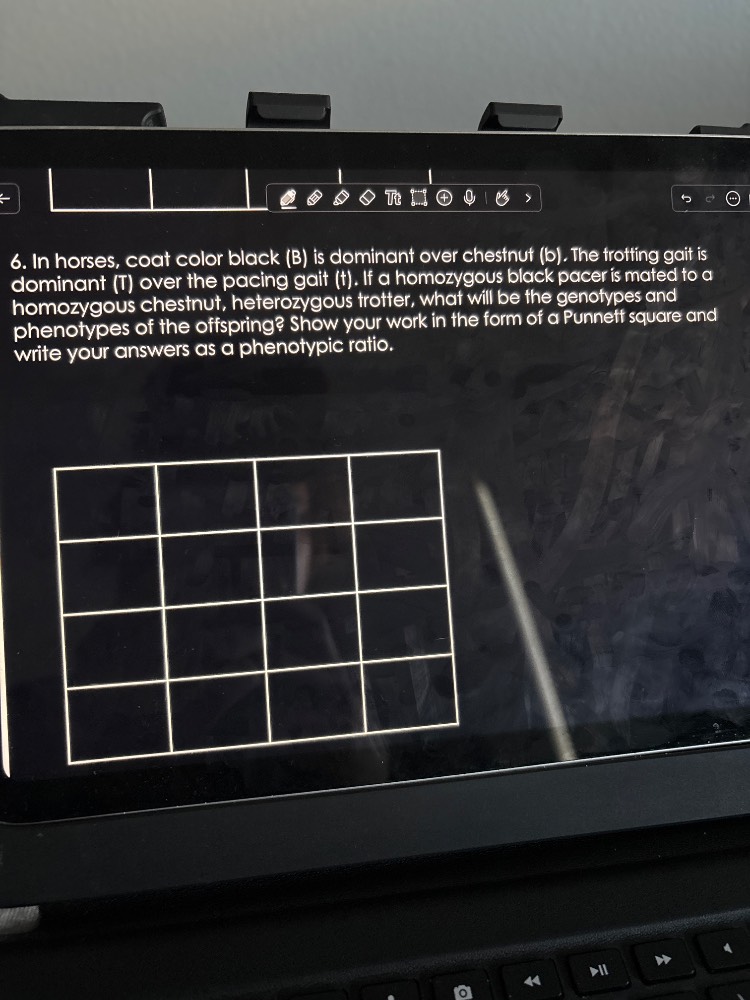
6. in horses, coat color black (b) is dominant over chestnut (b). the trotting gait is dominant (t) over the pacing gait (t). if a homozygous black pacer is mated to a homozygous chestnut, heterozygous trotter, what will be the genotypes and phenotypes of the offspring? show your work in the form of a punnett square and write your answers as a phenotypic ratio.
Answer
Explanation:
Step1: Identify parent genotypes
Homozygous black pacer: $BBtt$; Homozygous chestnut heterozygous trotter: $bbTt$
Step2: Find gamete combinations
Gametes from $BBtt$: $Bt$; Gametes from $bbTt$: $bT, bt$
Step3: Build Punnett square
| $Bt$ | $Bt$ | |
|---|---|---|
| $bT$ | $BbTt$ | $BbTt$ |
| $bt$ | $Bbtt$ | $Bbtt$ |
Step4: Determine phenotypes/ratios
$BbTt$ = black trotter; $Bbtt$ = black pacer. Count each type: 2 black trotters, 2 black pacers. Simplify ratio.
Answer:
Genotypes of offspring: $BbTt$ and $Bbtt$ Phenotypic ratio: 1 black trotter : 1 black pacer