there are international laws in place for underwater archaeological sites, but each country makes its own…
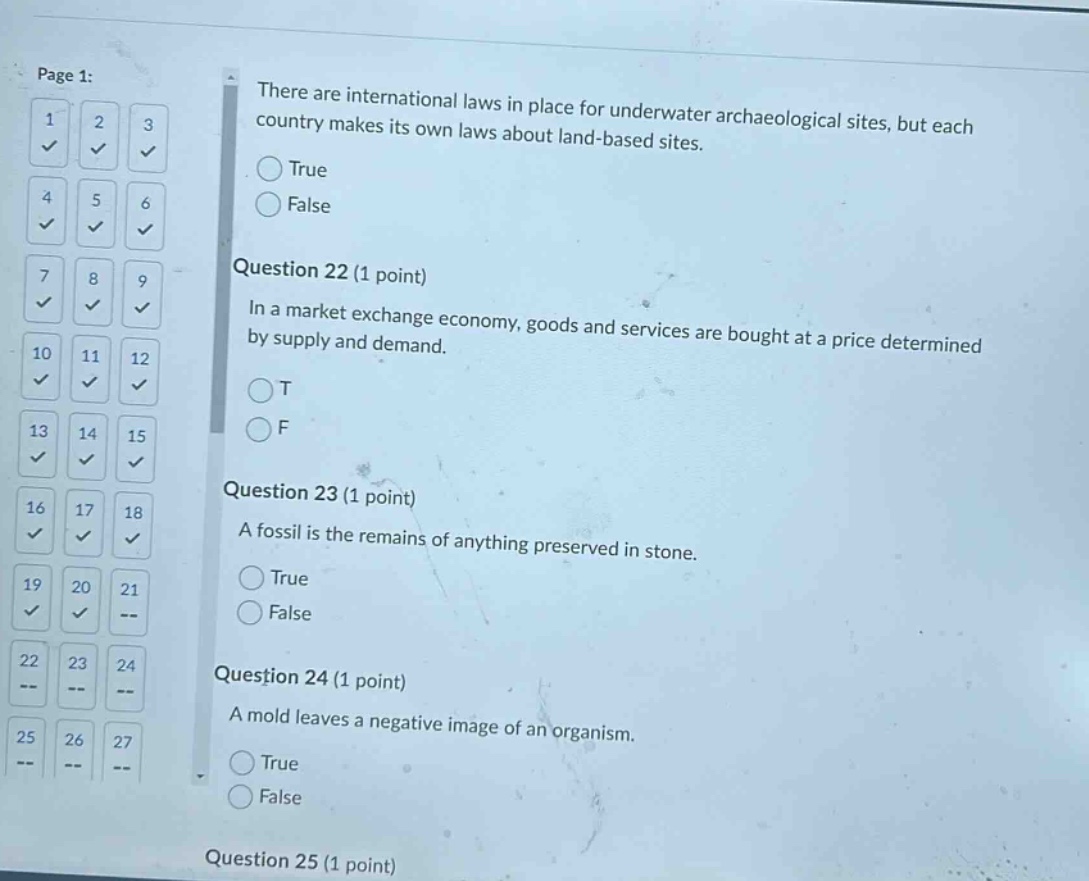
there are international laws in place for underwater archaeological sites, but each country makes its own laws about land - based sites.\ntrue\nfalse\nquestion 22 (1 point)\nin a market exchange economy, goods and services are bought at a price determined by supply and demand.\nt\nf\nquestion 23 (1 point)\na fossil is the remains of anything preserved in stone.\ntrue\nfalse\nquestion 24 (1 point)\na mold leaves a negative image of an organism.\ntrue\nfalse\nquestion 25 (1 point)
Answer
Brief Explanations:
- For Question 21: International laws exist for underwater archaeological sites, and countries have their own laws for land - based sites. This is a well - known fact in the context of cultural heritage and law.
- For Question 22: In a market exchange economy, the price of goods and services is indeed determined by supply and demand, which is a fundamental concept in economics.
- For Question 23: A fossil is the preserved remains or traces of organisms, not just anything preserved in stone. This is a basic definition in paleontology.
- For Question 24: A mold is a negative imprint or image of an organism, which is a common concept in paleontology and geology.
Answer:
Question 21: True Question 22: T Question 23: False Question 24: True