7. interpret how the proportion of the populations with the trait for antibiotic resistance change over time…
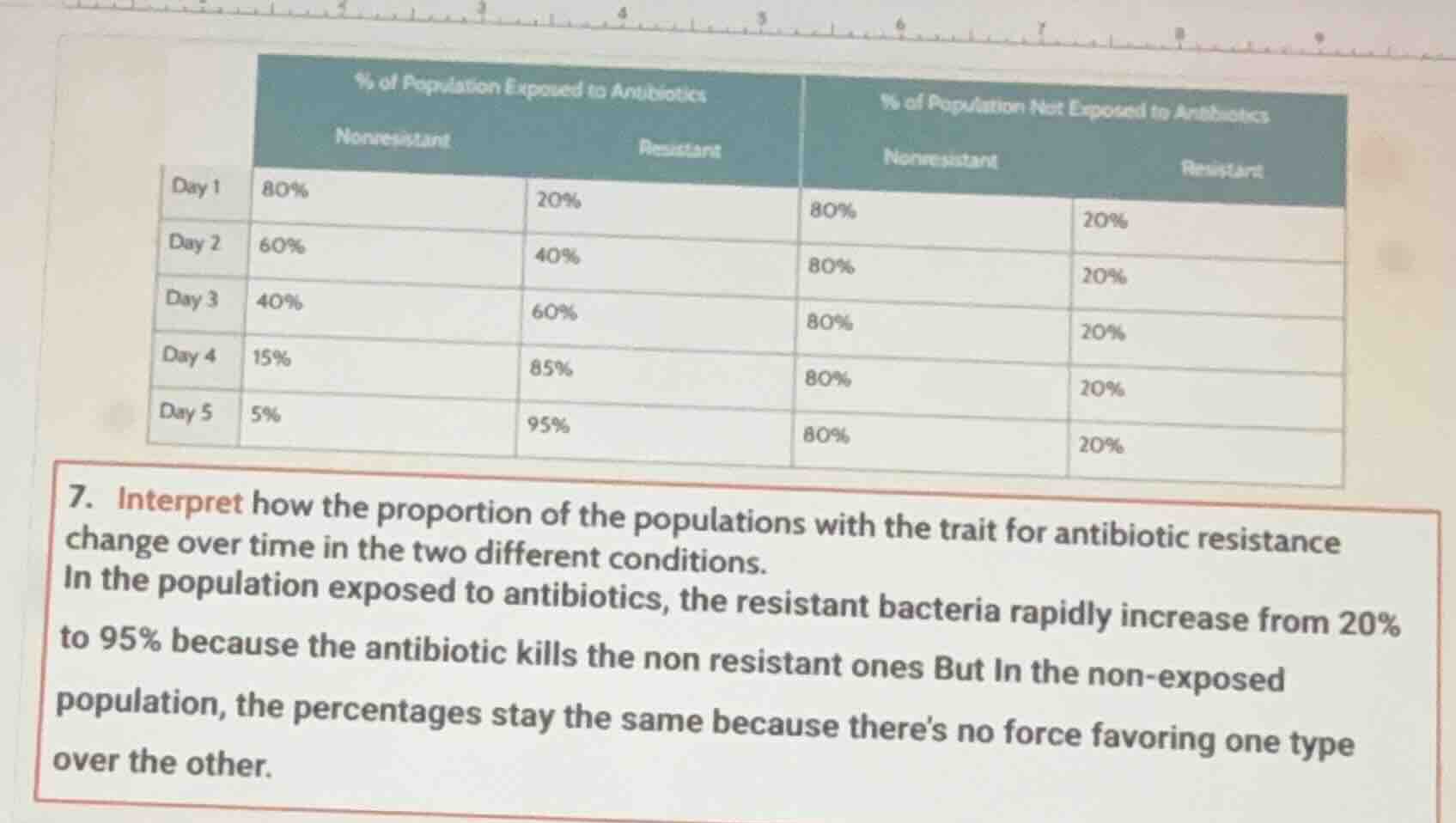
7. interpret how the proportion of the populations with the trait for antibiotic resistance change over time in the two different conditions. in the population exposed to antibiotics, the resistant bacteria rapidly increase from 20% to 95% because the antibiotic kills the non resistant ones but in the non - exposed population, the percentages stay the same because theres no force favoring one type over the other.
Answer
Brief Explanations:
- For the antibiotic-exposed population: The antibiotic acts as a selective pressure, killing nonresistant bacteria. This allows resistant bacteria to survive and become the dominant portion of the population over time.
- For the non-exposed population: Without the selective pressure of antibiotics, there is no advantage to having antibiotic resistance. The ratio of nonresistant to resistant bacteria remains stable because neither type is favored for survival or reproduction.
Answer:
- In the population exposed to antibiotics, the proportion of resistant bacteria increases drastically from 20% on Day 1 to 95% on Day 5. This occurs because the antibiotic eliminates nonresistant bacteria, leaving resistant bacteria to thrive and make up nearly the entire population.
- In the population not exposed to antibiotics, the proportion of resistant bacteria stays constant at 20% across all 5 days. This is because there is no selective pressure (antibiotics) to favor resistant bacteria over nonresistant ones, so the population ratio remains unchanged.