julia is trying to place a duckbilled platypus, lizard, bear, and monkey on a phylogenetic tree. she learns…
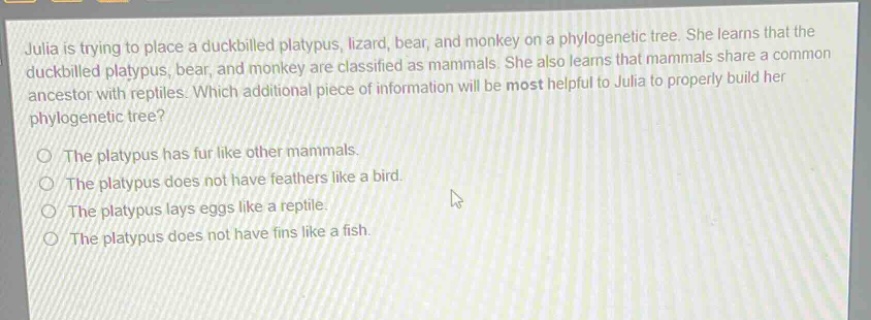
julia is trying to place a duckbilled platypus, lizard, bear, and monkey on a phylogenetic tree. she learns that the duckbilled platypus, bear, and monkey are classified as mammals. she also learns that mammals share a common ancestor with reptiles. which additional piece of information will be most helpful to julia to properly build her phylogenetic tree?\no the platypus has fur like other mammals.\no the platypus does not have feathers like a bird.\no the platypus lays eggs like a reptile.\no the platypus does not have fins like a fish.
Answer
Brief Explanations:
A phylogenetic tree shows evolutionary relationships. Since mammals share a common ancestor with reptiles and the platypus is a mammal, knowing that it lays eggs like a reptile provides key information about its evolutionary position, helping to build the tree. The other options (fur, lack of feathers, lack of fins) are less relevant to its relationship with reptiles and overall phylogenetic placement.
Answer:
The platypus lays eggs like a reptile.