karey is prescribed 600 mg of a medication that decays at a rate of 40% per day, d, according to the…
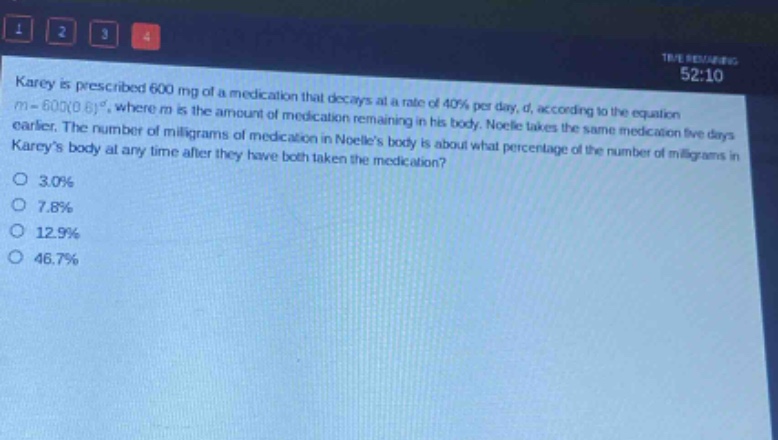
karey is prescribed 600 mg of a medication that decays at a rate of 40% per day, d, according to the equation m = 600(0.6)^d, where m is the amount of medication remaining in his body. noelle takes the same medication five days earlier. the number of milligrams of medication in noelles body is about what percentage of the number of milligrams in kareys body at any time after they have both taken the medication?\n3.0%\n7.8%\n12.9%\n46.7%
Answer
Explanation:
Step1: Find the amount of medication in Noelle's body after (d) days
Noelle takes the medication 5 days earlier. So the amount of medication in Noelle's body after (d) days is (m_N = 600(0.6)^{d + 5}). The amount of medication in Karey's body after (d) days is (m_K=600(0.6)^{d}).
Step2: Calculate the ratio of the amount of medication in Noelle's body to Karey's body
The ratio (r=\frac{m_N}{m_K}=\frac{600(0.6)^{d + 5}}{600(0.6)^{d}}). Using the exponent - rule (a^{m + n}=a^{m}\times a^{n}), we can rewrite ((0.6)^{d + 5}=(0.6)^{d}\times(0.6)^{5}). Then (r=\frac{600\times(0.6)^{d}\times(0.6)^{5}}{600\times(0.6)^{d}}). The (600) and ((0.6)^{d}) terms cancel out, and we get (r=(0.6)^{5}).
Step3: Calculate ((0.6)^{5}) and convert to percentage
((0.6)^{5}=0.6\times0.6\times0.6\times0.6\times0.6 = 0.07776). To convert to a percentage, we multiply by 100: (0.07776\times100 = 7.776%\approx7.8%).
Answer:
7.8%