knowledge check\nindicate which statements about sensitivity settings are true.\nselect submit to check your…
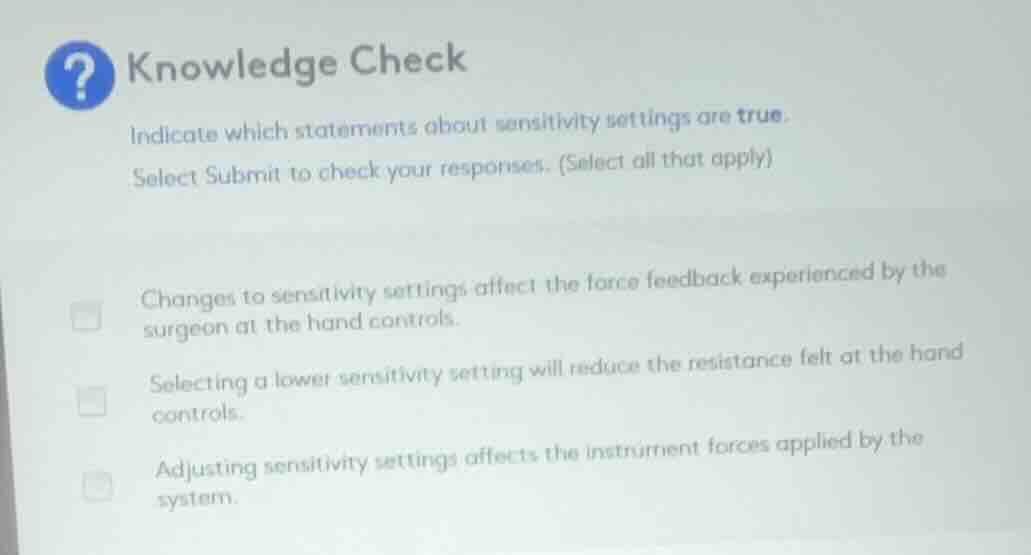
knowledge check\nindicate which statements about sensitivity settings are true.\nselect submit to check your responses. (select all that apply)\n\n- changes to sensitivity settings affect the force feedback experienced by the surgeon at the hand controls.\n- selecting a lower sensitivity setting will reduce the resistance felt at the hand controls.\n- adjusting sensitivity settings affects the instrument forces applied by the system.
Answer
Brief Explanations:
In robotic-assisted surgery systems (such as the da Vinci system), sensitivity settings primarily adjust the motion scaling between the surgeon's hand controls and the robotic instruments. These settings are designed to modulate the responsiveness and precision of movement. However, they do not typically alter the haptic feedback (force feedback) or the physical resistance felt by the surgeon at the console, nor do they change the actual physical force the robotic instruments are capable of applying to the tissue. The force feedback and resistance are usually independent of the motion sensitivity scaling. Therefore, none of the provided statements accurately describe the standard function of sensitivity settings in this context.
Answer:
None of the statements are true.