in a lab experiment, 520 bacteria are placed in a petri dish. the conditions are such that the number of…
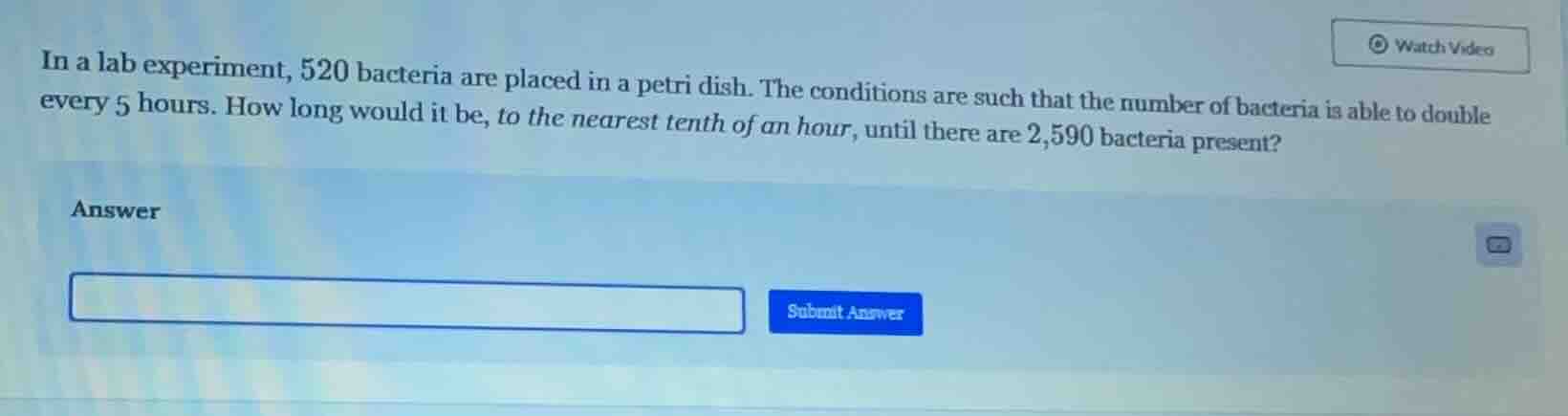
in a lab experiment, 520 bacteria are placed in a petri dish. the conditions are such that the number of bacteria is able to double every 5 hours. how long would it be, to the nearest tenth of an hour, until there are 2,590 bacteria present?\nanswer
Answer
Explanation:
Step1: Define exponential growth formula
The formula for doubling growth is $N(t) = N_0 \times 2^{\frac{t}{d}}$, where $N(t)=2590$, $N_0=520$, $d=5$ hours, $t$ is time to find.
Step2: Isolate the exponential term
Divide both sides by $N_0$: $\frac{2590}{520} = 2^{\frac{t}{5}}$ Simplify left side: $\frac{259}{52} \approx 4.9808 = 2^{\frac{t}{5}}$
Step3: Take log of both sides
Use natural logarithm: $\ln(4.9808) = \frac{t}{5} \times \ln(2)$
Step4: Solve for t
Rearrange to solve for $t$: $t = 5 \times \frac{\ln(4.9808)}{\ln(2)}$ Calculate values: $\ln(4.9808)\approx1.605$, $\ln(2)\approx0.6931$ $t = 5 \times \frac{1.605}{0.6931} \approx 5 \times 2.316 \approx 11.6$
Answer:
11.6