modeling a problem situation with a function\na science experiment begins with a bacterial population of 12…
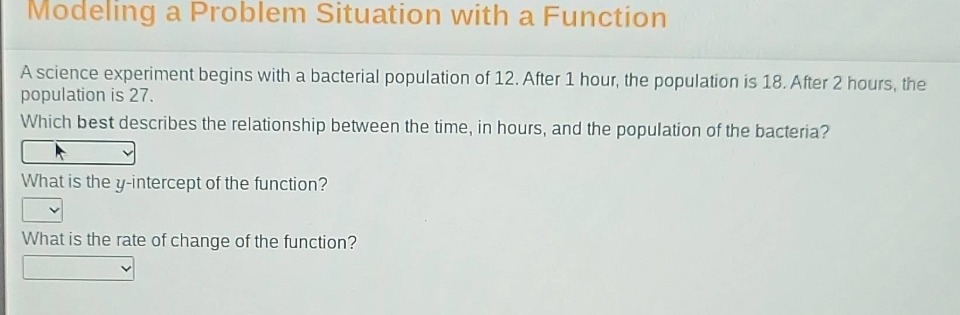
modeling a problem situation with a function\na science experiment begins with a bacterial population of 12. after 1 hour, the population is 18. after 2 hours, the population is 27.\nwhich best describes the relationship between the time, in hours, and the population of the bacteria?\nwhat is the y - intercept of the function?\nwhat is the rate of change of the function?
Answer
Explanation:
Step1: Determine the type of function
We observe that the population is growing exponentially. Let the general form of an exponential - growth function be $y = ab^{x}$, where $x$ is the time in hours, $y$ is the population of bacteria, $a$ is the initial population (when $x = 0$), and $b$ is the growth factor. When $x = 0$, $y=12$, so $a = 12$. When $x = 1$, $y = 18$, substituting into $y=ab^{x}$ gives $18=12b^{1}$, so $b=\frac{18}{12}=\frac{3}{2}$. The function is $y = 12(\frac{3}{2})^{x}$.
Step2: Find the y - intercept
The $y$-intercept of a function $y = f(x)$ is the value of $y$ when $x = 0$. For the function $y = 12(\frac{3}{2})^{x}$, when $x = 0$, $y=12(\frac{3}{2})^{0}=12\times1 = 12$.
Step3: Find the rate of change
For an exponential function $y = ab^{x}$, the rate of change is not constant. The ratio of consecutive $y$-values gives the common ratio. The ratio of the population at $x = 1$ to $x = 0$ is $\frac{18}{12}=\frac{3}{2}$, and the ratio of the population at $x = 2$ to $x = 1$ is $\frac{27}{18}=\frac{3}{2}$. The rate of change is a multiplicative factor of $\frac{3}{2}$.
Answer:
The relationship is exponential. The $y$-intercept is 12. The rate of change is $\frac{3}{2}$.