9 multiple choice 2 points\ncladograms are diagrams that represent evolutionary relationships among…
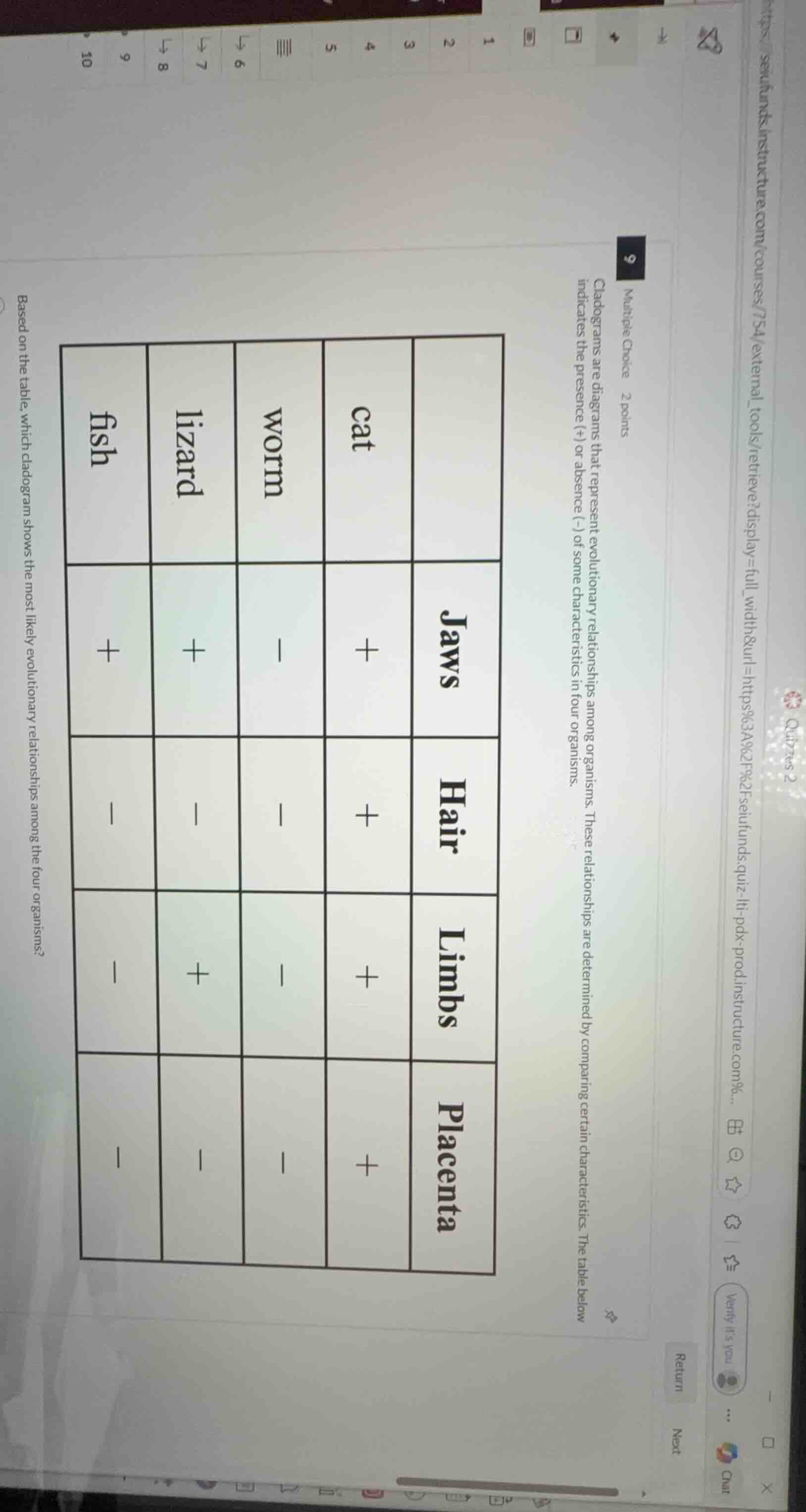
9 multiple choice 2 points\ncladograms are diagrams that represent evolutionary relationships among organisms. these relationships are determined by comparing certain characteristics. the table below indicates the presence (+) or absence (-) of some characteristics in four organisms.\n\n| | jaws | hair | limbs | placenta |\n| :--- | :---: | :---: | :---: | :---: |\n| cat | + | + | + | + |\n| worm | - | - | - | - |\n| lizard | + | - | + | - |\n| fish | + | - | - | - |\n\nbased on the table, which cladogram shows the most likely evolutionary relationships among the four organisms?
Answer
Explanation:
Step1: Identify the outgroup
The worm lacks all listed characteristics (Jaws, Hair, Limbs, Placenta), making it the outgroup that branched off first.
Step2: Determine the first derived trait
Jaws are present in the fish, lizard, and cat, but absent in the worm. This trait separates the fish from the worm.
Step3: Determine the second derived trait
Limbs are present in the lizard and cat, but absent in the fish. This trait separates the lizard and cat from the fish.
Step4: Determine the final derived traits
Hair and Placenta are present only in the cat. This indicates the cat is the most derived organism in this set, branching off after the lizard.
Step5: Construct the branching order
The evolutionary sequence based on increasing shared characteristics is: Worm $\rightarrow$ Fish $\rightarrow$ Lizard $\rightarrow$ Cat.
Answer:
The cladogram that shows the branching order as Worm, then Fish, then Lizard, and finally Cat is the most likely representation. The sequence of shared derived characters (synapomorphies) is Jaws, then Limbs, then Hair/Placenta.