from the outside, a whales flippers appear to be flat, solid objects. however, when scientists observed the…
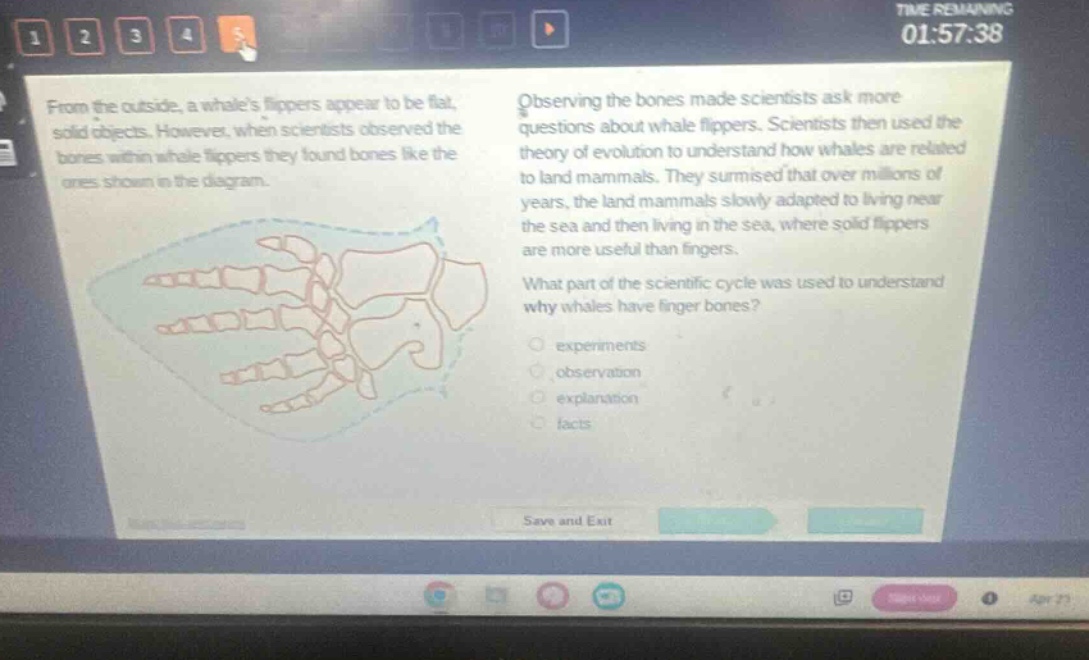
from the outside, a whales flippers appear to be flat, solid objects. however, when scientists observed the bones within whale flippers they found bones like the ones shown in the diagram. observing the bones made scientists ask more questions about whale flippers. scientists then used the theory of evolution to understand how whales are related to land mammals. they surmised that over millions of years, the land mammals slowly adapted to living near the sea and then living in the sea, where solid flippers are more useful than fingers. what part of the scientific cycle was used to understand why whales have finger - bones? experiments observation explanation facts
Answer
Answer:
C. explanation
Brief Explanations:
Scientists used the theory of evolution to explain why whales have finger - bones, which is an explanation step in the scientific cycle. They didn't conduct experiments, just made an observation - based explanation. Facts are not a part of the scientific cycle steps here, and simple observation was not the step to understand why they have finger - bones.