a parent that is heterozygous for a trait is crossed with a parent that is homozygous recessive for the same…
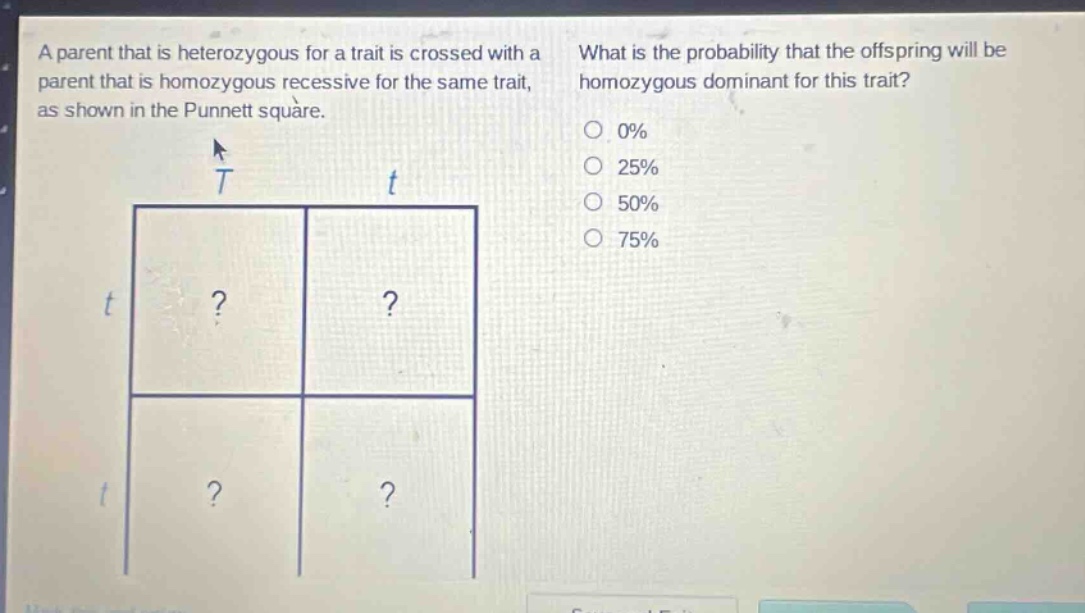
a parent that is heterozygous for a trait is crossed with a parent that is homozygous recessive for the same trait, as shown in the punnett square. what is the probability that the offspring will be homozygous dominant for this trait? 0% 25% 50% 75%
Answer
Explanation:
Step1: Identify the genotypes of the parents.
The problem states one parent is heterozygous (Tt) and the other is homozygous recessive (tt).
Step2: Determine the possible gametes for each parent.
The heterozygous parent (Tt) can produce gametes T and t. The homozygous recessive parent (tt) can only produce gamete t.
Step3: Construct the Punnett square.
Set up a Punnett square with the gametes from each parent along the top and side.
| T | t | |
|---|---|---|
| t | Tt | tt |
| t | Tt | tt |
Step4: Determine the genotypes of the offspring.
Fill in the squares by combining the gametes: The possible genotypes of the offspring are Tt and tt.
Step5: Calculate the probability of homozygous dominant offspring.
Homozygous dominant genotype is TT. Count the number of squares with the TT genotype. Number of TT offspring = 0 Total number of possible offspring = 4
Step6: Express the probability as a percentage.
The probability of homozygous dominant offspring (TT) is $\frac{0}{4} = 0$. $0 \times 100% = 0%$
Answer:
0%