the passage below describes the same species of fish. in a species of fish, some fish have long fins and…
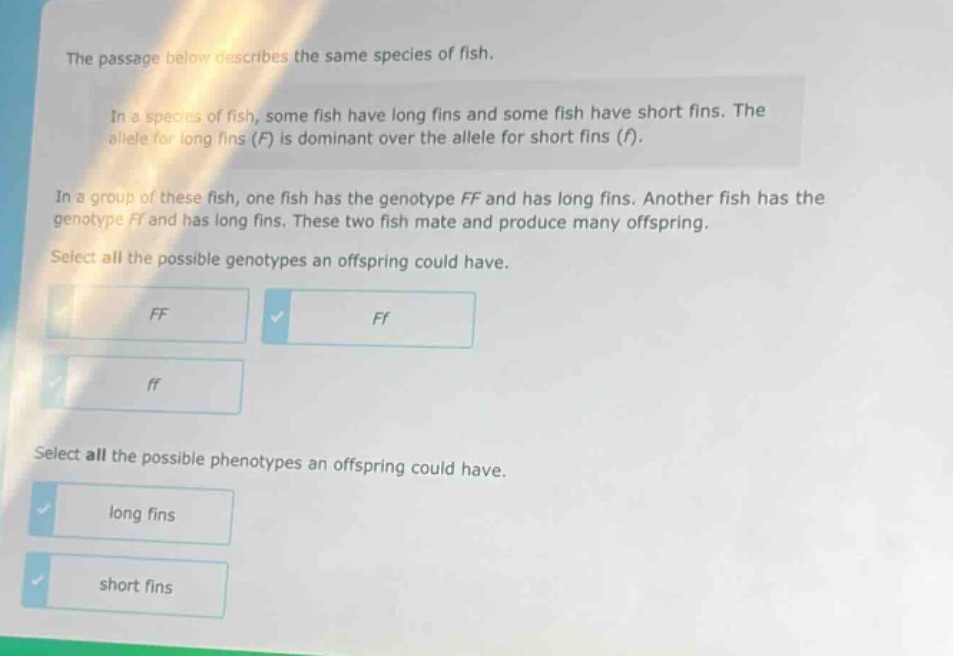
the passage below describes the same species of fish. in a species of fish, some fish have long fins and some fish have short fins. the allele for long fins (f) is dominant over the allele for short fins (f). in a group of these fish, one fish has the genotype ff and has long fins. another fish has the genotype ff and has long fins. these two fish mate and produce many offspring. select all the possible genotypes an offspring could have. ff ff ff select all the possible phenotypes an offspring could have. long fins short fins
Answer
Explanation:
Step1: Set up Punnett - square
The genotypes of the parent fish are FF and Ff. The first parent can only contribute F alleles, and the second parent can contribute either F or f alleles.
Step2: Determine possible genotypes
When we cross FF and Ff, the possible genotypes of the offspring are determined by combining the alleles from the parents. The possible combinations are FF (from F of first parent and F of second parent) and Ff (from F of first parent and f of second parent). There is no way to get ff as the first parent has no f alleles.
Step3: Determine possible phenotypes
Since the allele for long fins (F) is dominant over the allele for short fins (f), both FF and Ff genotypes will result in the phenotype of long fins. There is no short - fin phenotype possible from this cross as there is no ff genotype.
Answer:
Possible genotypes: A. FF, B. Ff Possible phenotypes: A. long fins