in pea plants, purple flower color, c, is dominant to white flower color, c. the table shows the frequencies…
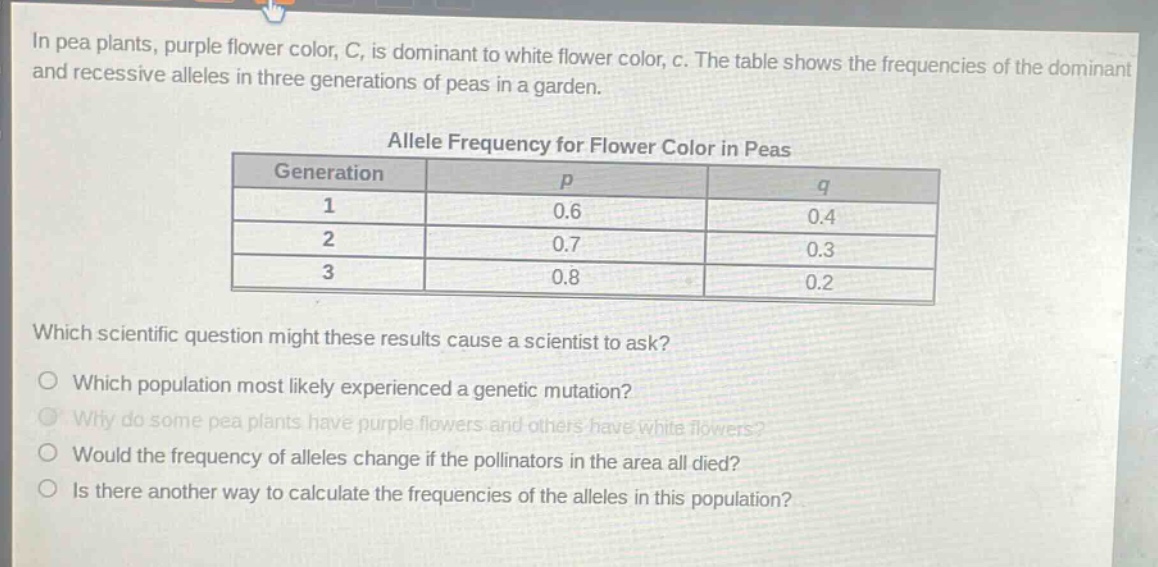
in pea plants, purple flower color, c, is dominant to white flower color, c. the table shows the frequencies of the dominant and recessive alleles in three generations of peas in a garden.\n\nallele frequency for flower color in peas\n| generation | p | q |\n| ---- | ---- | ---- |\n| 1 | 0.6 | 0.4 |\n| 2 | 0.7 | 0.3 |\n| 3 | 0.8 | 0.2 |\n\nwhich scientific question might these results cause a scientist to ask?\no which population most likely experienced a genetic mutation?\no why do some pea plants have purple flowers and others have white flowers?\no would the frequency of alleles change if the pollinators in the area all died?\no is there another way to calculate the frequencies of the alleles in this population?
Answer
Brief Explanations:
The table shows changing allele frequencies across generations, which prompts inquiry into factors affecting these frequencies. The question about pollinators dying addresses a potential environmental influence on allele frequency changes, which is a scientific question arising from the observed data. Other options either misunderstand the data (e.g., no multiple populations mentioned for mutation question), ask for basic knowledge already implied (flower color reason), or focus on calculation methods rather than causal factors.
Answer:
C. Would the frequency of alleles change if the pollinators in the area all died?