in pea plants, tallness (t) is dominant to shortness (t). what are the predicted percentages of the…
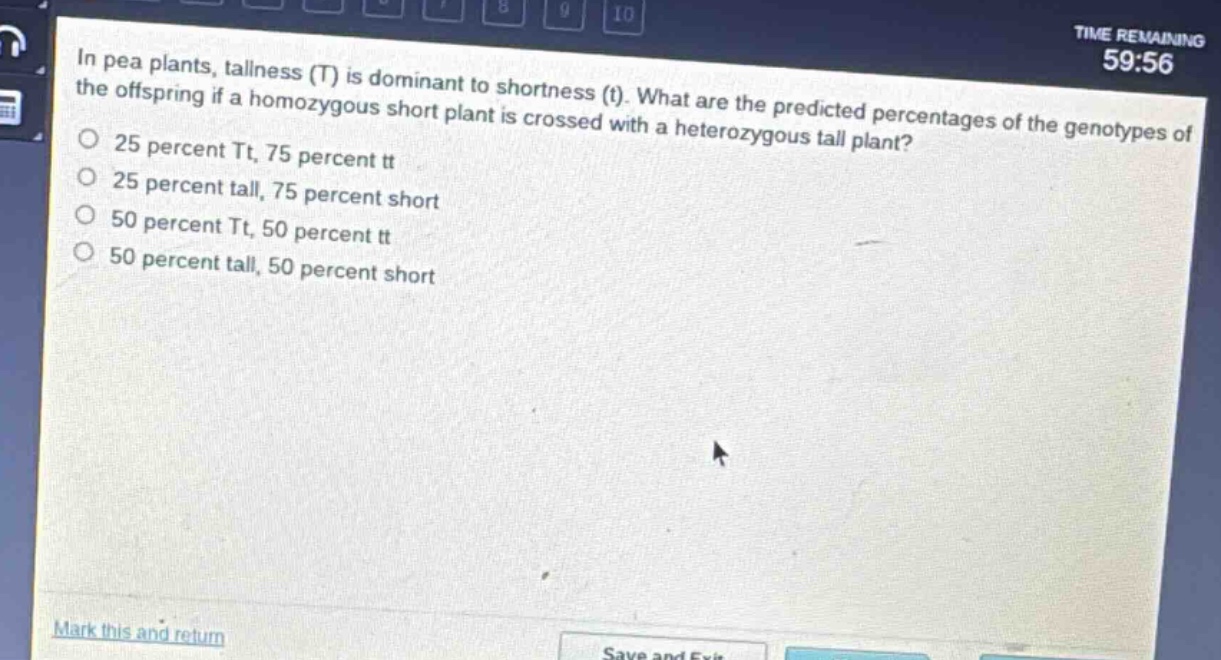
in pea plants, tallness (t) is dominant to shortness (t). what are the predicted percentages of the genotypes of the offspring if a homozygous short plant is crossed with a heterozygous tall plant?\n25 percent tt, 75 percent tt\n25 percent tall, 75 percent short\n50 percent tt, 50 percent tt\n50 percent tall, 50 percent short
Answer
Answer:
C. 50 percent Tt, 50 percent tt
Explanation:
Step1: Determine the genotypes of the parents
The homozygous short plant has genotype ( tt ), and the heterozygous tall plant has genotype ( Tt ).
Step2: Set up the Punnett square
| ( T ) | ( t ) | |
|---|---|---|
| ( t ) | ( Tt ) | ( tt ) |
| ( t ) | ( Tt ) | ( tt ) |
Step3: Analyze the results
Out of 4 possible offspring genotypes (2 ( Tt ) and 2 ( tt )), ( \frac{2}{4}=50% ) are ( Tt ) and ( \frac{2}{4}=50% ) are ( tt ).