in pea plants, yellow seed color is dominant and green seed color is recessive. what will the generations…
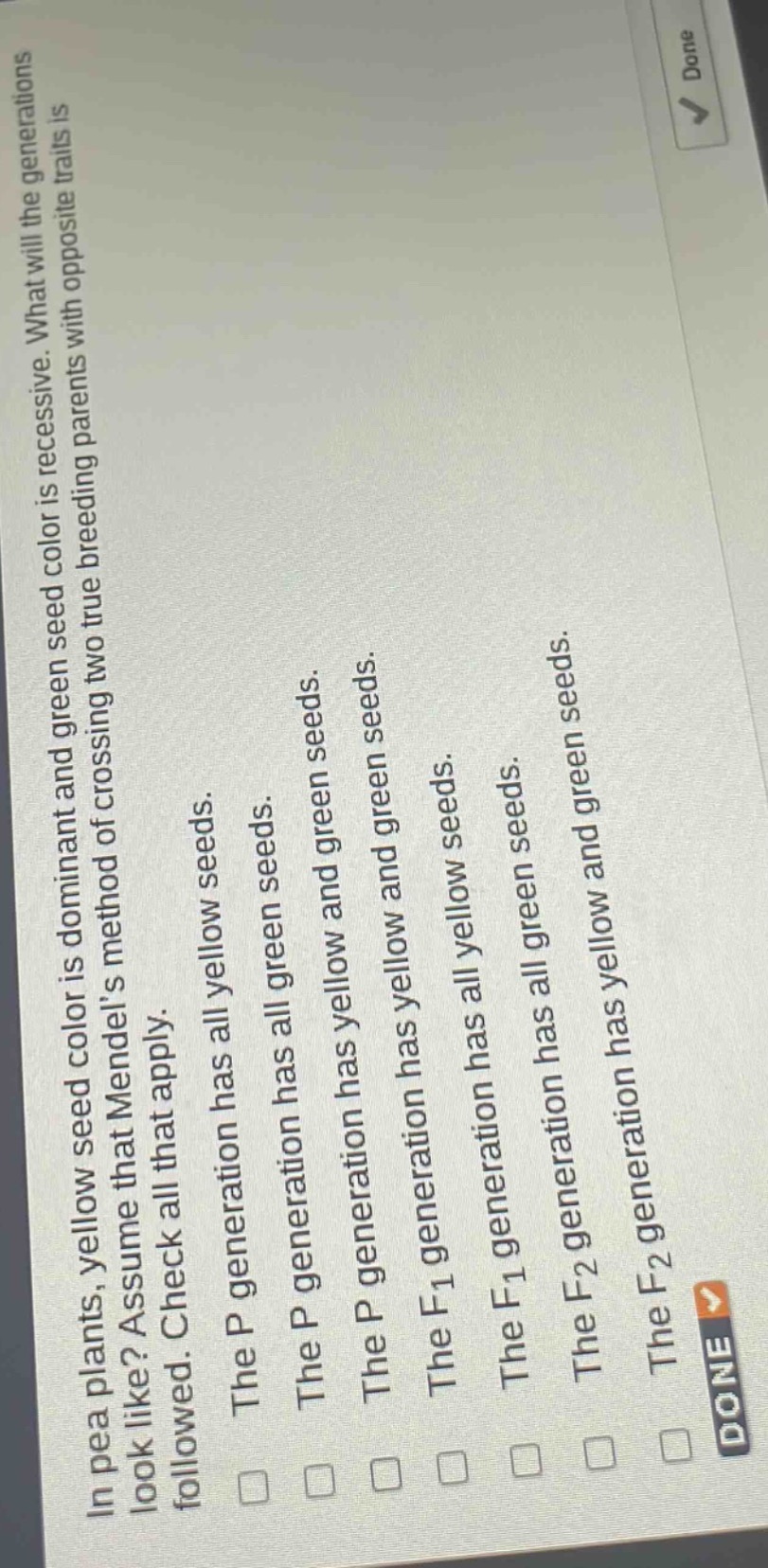
in pea plants, yellow seed color is dominant and green seed color is recessive. what will the generations look like? assume that mendels method of crossing two true - breeding parents with opposite traits is followed. check all that apply. the p generation has all yellow seeds. the p generation has all green seeds. the p generation has yellow and green seeds. the f1 generation has yellow and green seeds. the f1 generation has all yellow seeds. the f2 generation has all green seeds. the f2 generation has yellow and green seeds.
Answer
Brief Explanations:
Mendel's experiments showed that when true - breeding parents with contrasting traits (yellow - dominant and green - recessive seed color in pea plants) are crossed, the F1 generation shows only the dominant trait. The F2 generation shows a 3:1 ratio of dominant to recessive traits. The P generation has pure - breeding parents. So, the P generation has all yellow seeds (dominant pure - breeding) and all green seeds (recessive pure - breeding), and the F1 generation has all yellow seeds (heterozygous). The F2 generation has both yellow and green seeds in a 3:1 ratio.
Answer:
The P generation has all yellow seeds. The P generation has all green seeds. The F1 generation has all yellow seeds. The F2 generation has yellow and green seeds.