the pedigree of a family with a history of a particular genetic disease is shown below. squares represent…
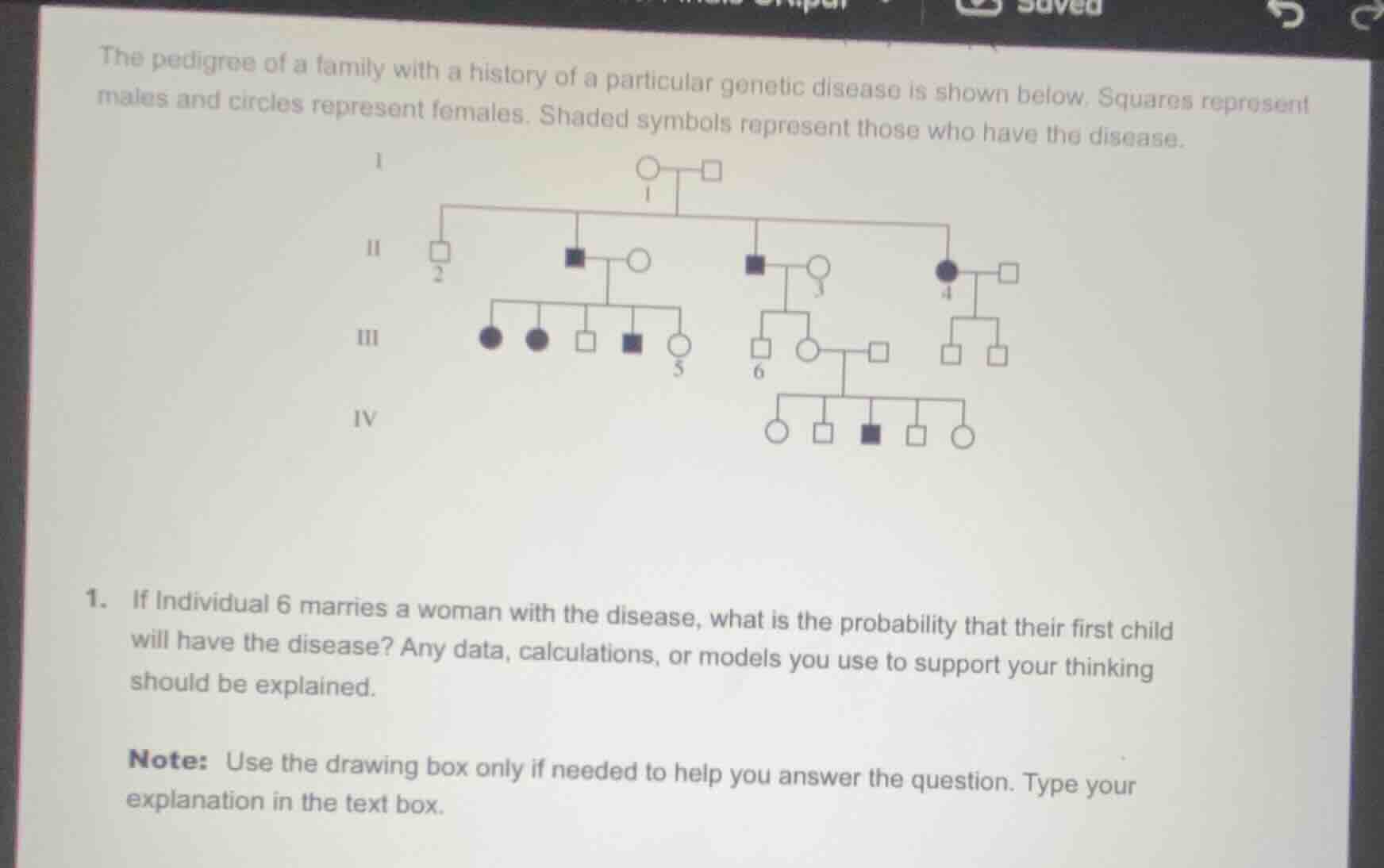
the pedigree of a family with a history of a particular genetic disease is shown below. squares represent males and circles represent females. shaded symbols represent those who have the disease.\n\n1. if individual 6 marries a woman with the disease, what is the probability that their first child will have the disease? any data, calculations, or models you use to support your thinking should be explained.\n\nnote: use the drawing box only if needed to help you answer the question. type your explanation in the text box.
Answer
Explanation:
Step1: Determine the mode of inheritance
The disease appears in every generation and affected individuals have at least one affected parent, suggesting an autosomal dominant trait.
Step2: Identify the genotype of Individual 6
Individual 6 is an unaffected male ($aa$) born to an affected father ($Aa$) and an unaffected mother ($aa$).
Step3: Identify the genotype of the woman
The woman has the disease. Since the disease is rare, she is likely heterozygous ($Aa$).
Step4: Perform the genetic cross
The cross is between Individual 6 ($aa$) and the affected woman ($Aa$). $$aa \times Aa \rightarrow \frac{1}{2} Aa, \frac{1}{2} aa$$
Step5: Calculate the probability
The probability of the first child having the disease ($Aa$) is $50%$.
Answer:
The probability that their first child will have the disease is 0.5 (or 50%).