the picture shows two different species of mammals that use wings to glide among tree tops. however…
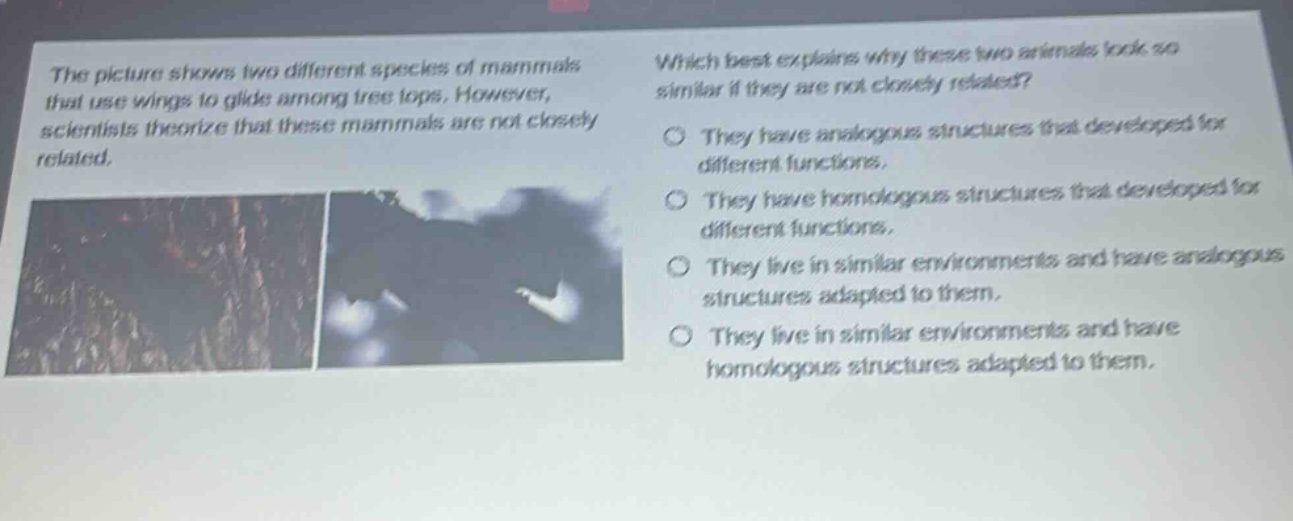
the picture shows two different species of mammals that use wings to glide among tree tops. however, scientists theorize that these mammals are not closely related. which best explains why these two animals look so similar if they are not closely related? they have analogous structures that developed for different functions. they have homologous structures that developed for different functions. they live in similar environments and have analogous structures adapted to them. they live in similar environments and have homologous structures adapted to them.
Answer
Brief Explanations:
- Analogous structures are those that have similar functions but different evolutionary origins.
- Homologous structures have a common evolutionary origin but may have different functions.
- Since the two mammals are not closely related (different evolutionary origins) but have similar structures (wings for gliding, same function) adapted to similar environments (tree - top gliding), we consider the concepts of analogous structures.
- Option 1 is wrong because the structures have the same function (gliding).
- Option 2 is wrong because they are not closely related (no common evolutionary origin for homologous structures in this context).
- Option 4 is wrong because they are not closely related (no homologous structures in this sense).
Answer:
They live in similar environments and have analogous structures adapted to them.