a population of ducks lives in an area that floods many times each year. some of the ducks are better at…
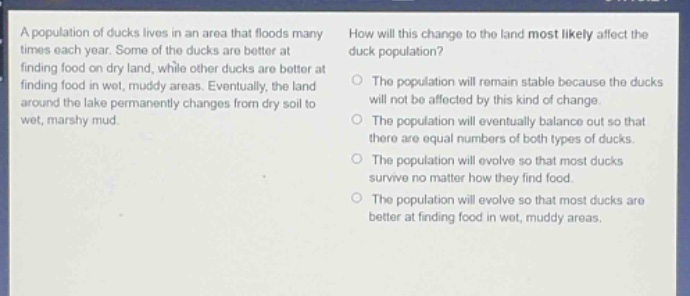
a population of ducks lives in an area that floods many times each year. some of the ducks are better at finding food on dry land, while other ducks are better at finding food in wet, muddy areas. eventually, the land around the lake permanently changes from dry soil to wet, marshy mud. how will this change to the land most likely affect the duck population? the population will remain stable because the ducks will not be affected by this kind of change. the population will eventually balance out so that there are equal numbers of both types of ducks. the population will evolve so that most ducks survive no matter how they find food. the population will evolve so that most ducks are better at finding food in wet, muddy areas.
Answer
Brief Explanations:
This is a question about the impact of environmental change (land changing from dry soil to wet, marshy mud) on a duck population. According to the theory of natural selection, organisms that are better adapted to their environment are more likely to survive and reproduce. In this case, ducks that are better at finding food in wet, muddy areas will have a survival advantage. Over time, through the process of natural selection, the genes of these better - adapted ducks will be more likely to be passed on to the next generation.
Answer:
The population will evolve so that most ducks are better at finding food in wet, muddy areas.