a population of rabbits has individuals with fur coloring that ranges from white to brown. the population…
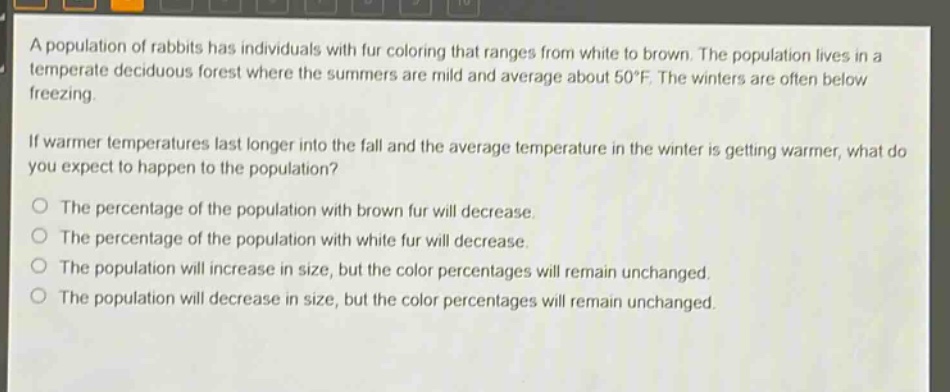
a population of rabbits has individuals with fur coloring that ranges from white to brown. the population lives in a temperate deciduous forest where the summers are mild and average about 50°f. the winters are often below freezing.\n\nif warmer temperatures last longer into the fall and the average temperature in the winter is getting warmer, what do you expect to happen to the population?\n\nthe percentage of the population with brown fur will decrease.\nthe percentage of the population with white fur will decrease.\nthe population will increase in size, but the color percentages will remain unchanged.\nthe population will decrease in size, but the color percentages will remain unchanged.
Answer
Brief Explanations:
In a temperate deciduous forest, white - furred rabbits are likely camouflaged in winter snow. With warmer winters and less snow, white - furred rabbits will be more visible to predators, reducing their survival rate and thus decreasing the percentage of white - furred individuals in the population.
Answer:
The percentage of the population with white fur will decrease.