pretest: evolution\nlayer e is the deepest layer. whats the relative age of a fossil found in layer c?\nthe…
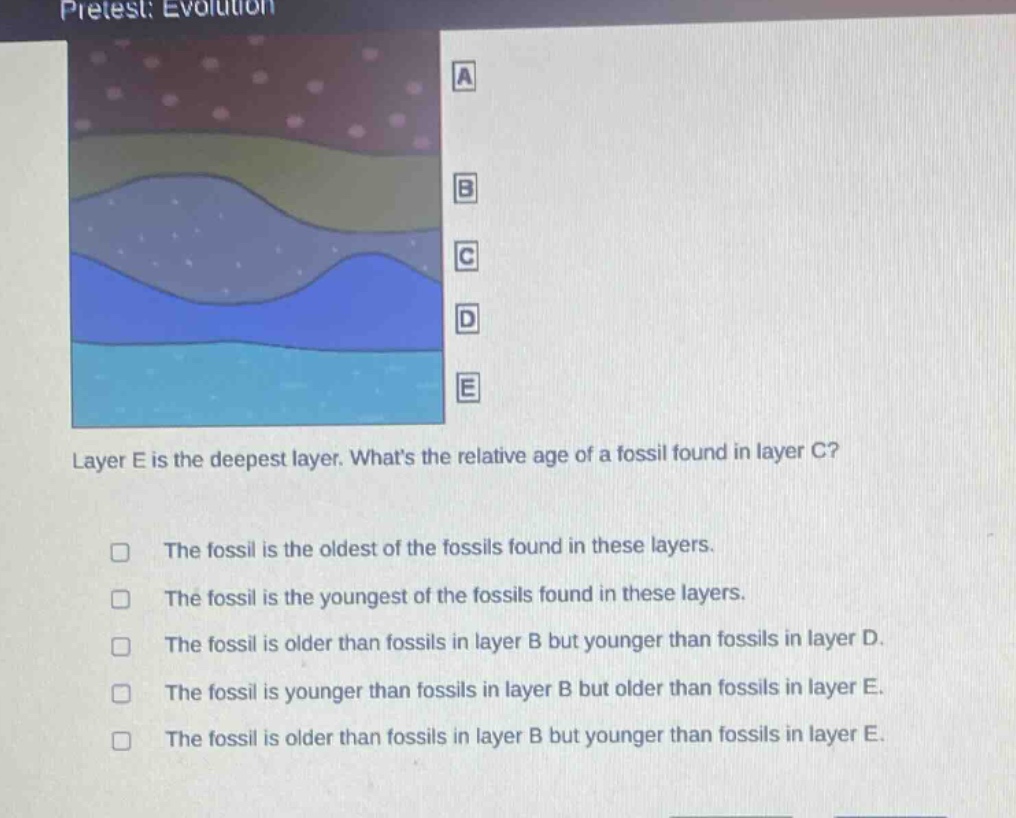
pretest: evolution\nlayer e is the deepest layer. whats the relative age of a fossil found in layer c?\nthe fossil is the oldest of the fossils found in these layers.\nthe fossil is the youngest of the fossils found in these layers.\nthe fossil is older than fossils in layer b but younger than fossils in layer d.\nthe fossil is younger than fossils in layer b but older than fossils in layer e.\nthe fossil is older than fossils in layer b but younger than fossils in layer e.
Answer
Brief Explanations:
In geology, the principle of superposition states that in undisturbed sedimentary rock layers, the oldest layers are at the bottom and the youngest are at the top. Layer E is the deepest (oldest), layer D is above E (younger than E), layer C is above D (younger than D), and layer B is above C (younger than C). So a fossil in layer C is younger than fossils in layer B but older than fossils in layer E.
Answer:
The fossil is younger than fossils in layer B but older than fossils in layer E.