in the punnett square, fill in the shaded boxes with the alleles of each parent. use b for the dominant…
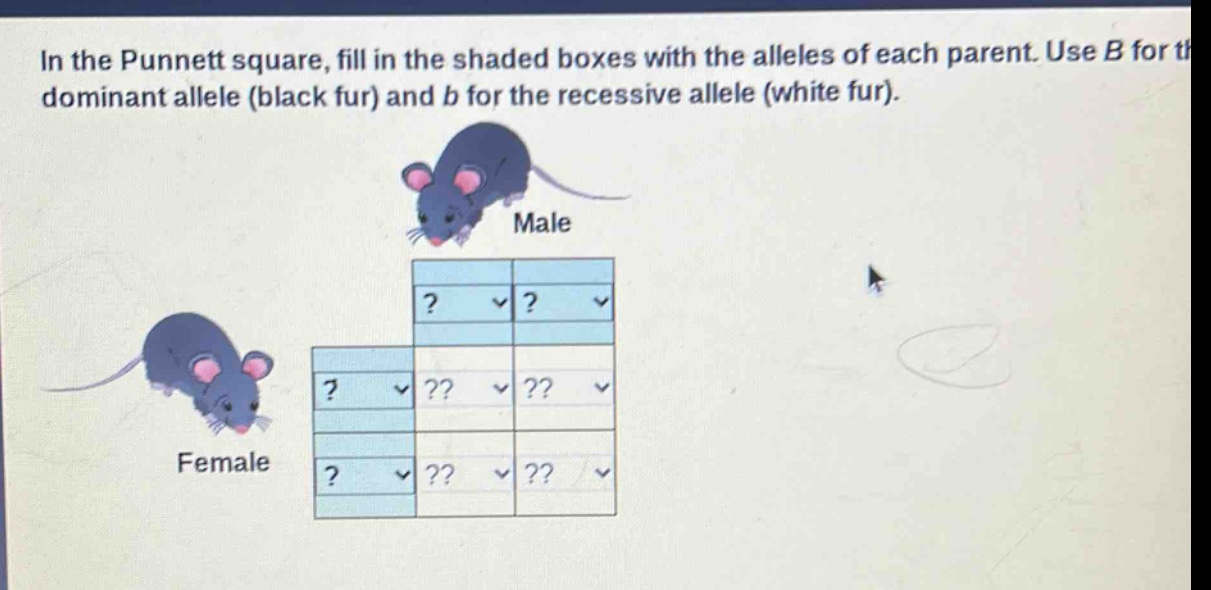
in the punnett square, fill in the shaded boxes with the alleles of each parent. use b for the dominant allele (black fur) and b for the recessive allele (white fur).
Answer
Explanation:
Step1: Identify parent - allele contribution
The alleles of the parents are placed along the top (male) and side (female) of the Punnett square. Each parent contributes one allele to each offspring.
Step2: Fill the top - row (male alleles)
If we assume the male has alleles, we fill the top - row shaded boxes. Let's say the male is heterozygous (Bb), so the top - row boxes will be B and b.
Step3: Fill the side - column (female alleles)
If the female is also heterozygous (Bb), the side - column shaded boxes will be B and b.
Answer:
Top - row shaded boxes: B, b; Side - column shaded boxes: B, b