question 25 (1 point)\nin a market exchange economy, goods and services are bought at a price determined by…
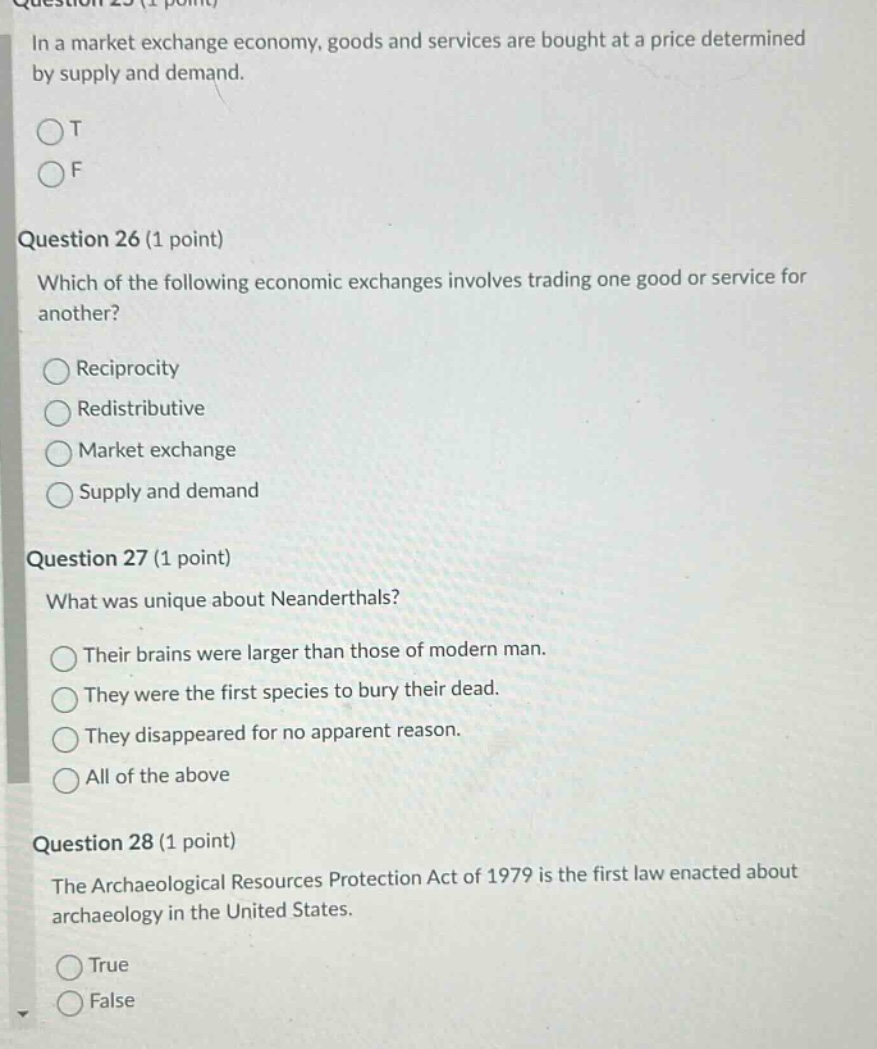
question 25 (1 point)\nin a market exchange economy, goods and services are bought at a price determined by supply and demand.\n○t\n○f\n\nquestion 26 (1 point)\nwhich of the following economic exchanges involves trading one good or service for another?\n○reciprocity\n○redistributive\n○market exchange\n○supply and demand\n\nquestion 27 (1 point)\nwhat was unique about neanderthals?\n○their brains were larger than those of modern man.\n○they were the first species to bury their dead.\n○they disappeared for no apparent reason.\n○all of the above\n\nquestion 28 (1 point)\nthe archaeological resources protection act of 1979 is the first law enacted about archaeology in the united states.\n○true\n○false
Answer
Brief Explanations:
- Question 25: In a market - exchange economy, supply and demand interact to determine prices of goods and services. So the statement is true.
- Question 26: Reciprocity involves trading one good or service for another. Redistributive is about collection and re - distribution, market exchange is about buying/selling at a price determined by supply and demand, and supply and demand are factors determining price, not the act of trading one for another.
- Question 27: Neanderthals had larger brains than modern humans, they were among the first to bury their dead, and their disappearance remains a mystery. So all the statements are true.
- Question 28: The Archaeological Resources Protection Act of 1979 was not the first law about archaeology in the US. There were earlier laws related to archaeological sites and artifacts. So the statement is false.
Answer:
- Question 25: T
- Question 26: Reciprocity
- Question 27: All of the above
- Question 28: False