1. how are reptiles and fish alike?\n a) both have gills b) both are invertebrates\n c)both are cold blooded…
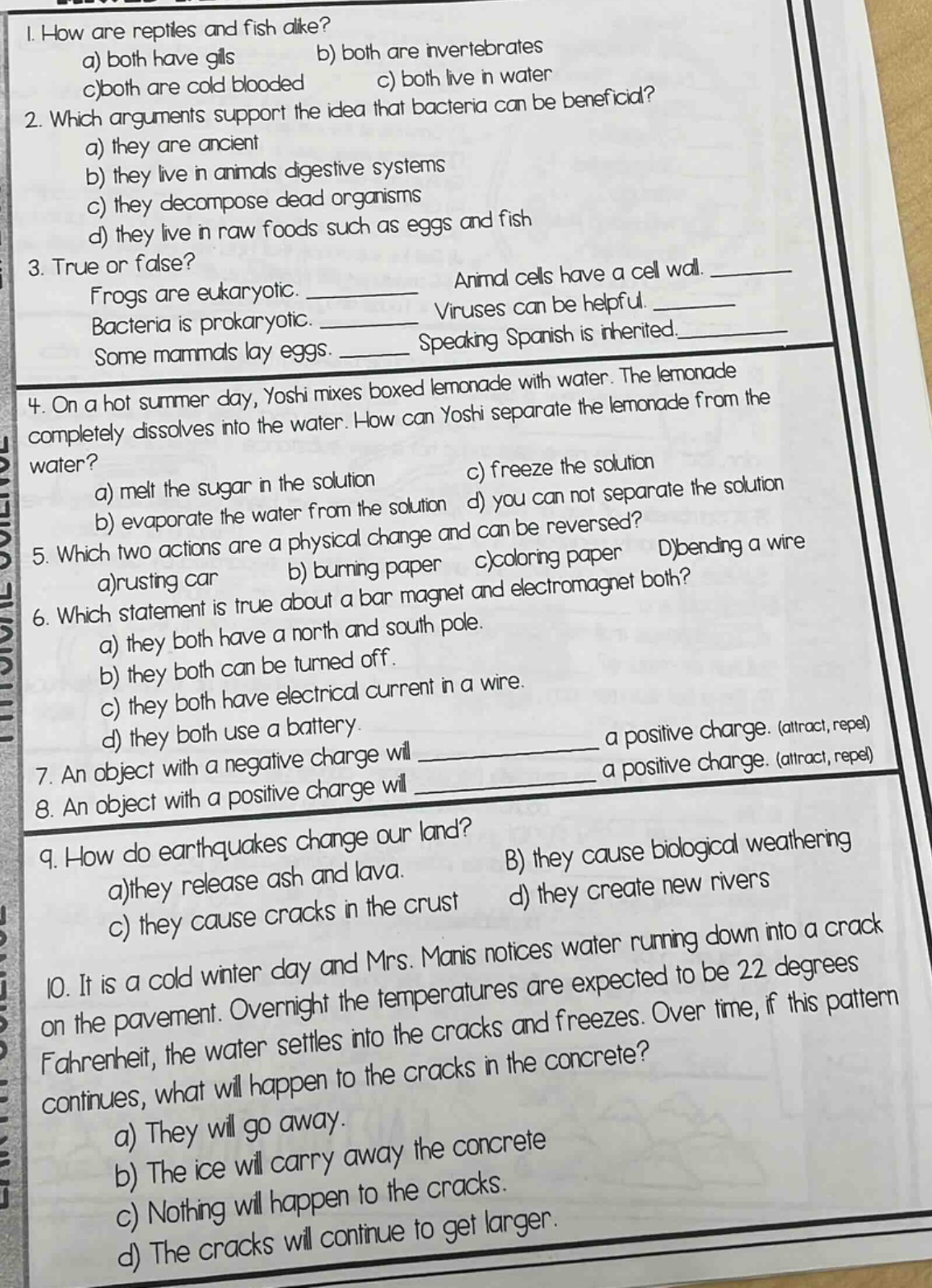
1. how are reptiles and fish alike?\n a) both have gills b) both are invertebrates\n c)both are cold blooded c) both live in water\n2. which arguments support the idea that bacteria can be beneficial?\n a) they are ancient\n b) they live in animals digestive systems\n c) they decompose dead organisms\n d) they live in raw foods such as eggs and fish\n3. true or false?\n frogs are eukaryotic. __________ animal cells have a cell wall. __________\n bacteria is prokaryotic. __________ viruses can be helpful. __________\n some mammals lay eggs. __________ speaking spanish is inherited. __________\n4. on a hot summer day, yoshi mixes boxed lemonade with water. the lemonade completely dissolves into the water. how can yoshi separate the lemonade from the water?\n a) melt the sugar in the solution c) freeze the solution\n b) evaporate the water from the solution d) you can not separate the solution\n5. which two actions are a physical change and can be reversed?\n a)rusting car b) burning paper c)coloring paper d)bending a wire\n6. which statement is true about a bar magnet and electromagnet both?\n a) they both have a north and south pole.\n b) they both can be turned off.\n c) they both have electrical current in a wire.\n d) they both use a battery.\n7. an object with a negative charge will __________ a positive charge. (attract, repel)\n8. an object with a positive charge will __________ a positive charge. (attract, repel)\n9. how do earthquakes change our land?\n a)they release ash and lava. b) they cause biological weathering\n c) they cause cracks in the crust d) they create new rivers\n10. it is a cold winter day and mrs. manis notices water running down into a crack on the pavement. overnight the temperatures are expected to be 22 degrees fahrenheit, the water settles into the cracks and freezes. over time, if this pattern continues, what will happen to the cracks in the concrete?\n a) they will go away.\n b) the ice will carry away the concrete\n c) nothing will happen to the cracks.\n d) the cracks will continue to get larger.
Answer
Answer:
- c) both are cold - blooded
- b) they live in animals' digestive systems; c) they decompose dead organisms
- Frogs are eukaryotic. - True; Animal cells have a cell wall. - False; Bacteria is prokaryotic. - True; Viruses can be helpful. - True; Some mammals lay eggs. - True; Speaking Spanish is inherited. - False
- b) evaporate the water from the solution
- c) coloring paper; D) bending a wire
- a) they both have a north and south pole.
- attract
- attract
- c) they cause cracks in the crust
- d) The cracks will continue to get larger.
Explanation:
Step1: Reptile and fish characteristics
Reptiles and fish are cold - blooded. Reptiles don't always have gills, they are vertebrates and not all live in water.
Step2: Beneficial bacteria
Bacteria in digestive systems aid digestion and decomposing dead organisms is a beneficial ecological role. Age and presence in raw foods aren't benefits.
Step3: Biological facts
Frogs are eukaryotes. Animal cells lack a cell wall. Bacteria are prokaryotes. Some viruses can be beneficial. Platypus is an egg - laying mammal. Language is not inherited.
Step4: Separating solutions
Evaporating water leaves behind dissolved substances like in lemonade - water solution. Melting sugar doesn't separate them, freezing doesn't work well.
Step5: Physical changes
Coloring paper and bending a wire are physical changes as no new substances are formed. Rusting and burning are chemical changes.
Step6: Magnet properties
Both bar and electromagnets have north and south poles. Only electromagnets can be turned off, have electrical current and use a battery.
Step7 - 8: Electric charge interactions
Opposite charges attract.
Step9: Earthquake effects
Earthquakes cause cracks in the crust. Volcanoes release ash and lava, not earthquakes. They don't cause biological weathering or create new rivers directly.
Step10: Water - ice expansion
When water freezes in cracks, it expands, making cracks larger over time.