robert decides to go for a run when he gets home from school. as he begins running, his breathing rate…
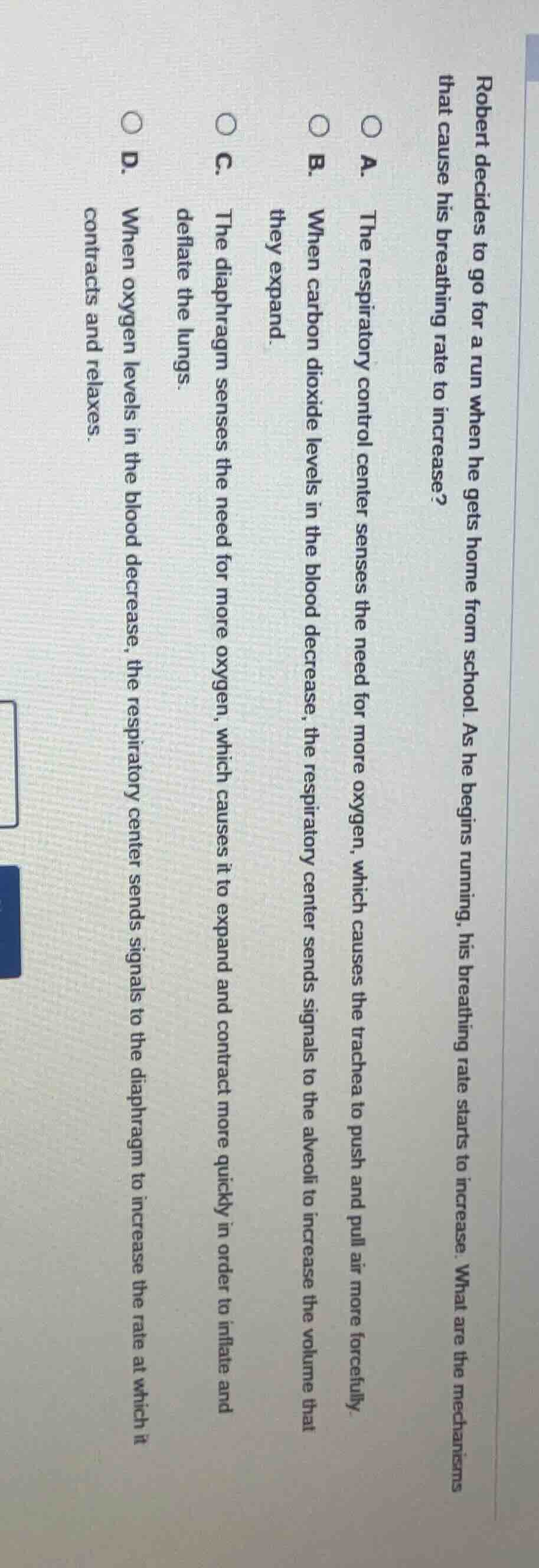
robert decides to go for a run when he gets home from school. as he begins running, his breathing rate starts to increase. what are the mechanisms that cause his breathing rate to increase?\n\na. the respiratory control center senses the need for more oxygen, which causes the trachea to push and pull air more forcefully.\nb. when carbon dioxide levels in the blood decrease, the respiratory center sends signals to the alveoli to increase the volume that they expand.\nc. the diaphragm senses the need for more oxygen, which causes it to expand and contract more quickly in order to inflate and deflate the lungs.\nd. when oxygen levels in the blood decrease, the respiratory center sends signals to the diaphragm to increase the rate at which it contracts and relaxes.
Answer
Brief Explanations:
The respiratory control center, located in the medulla oblongata and pons of the brainstem, monitors the levels of gases in the blood. During physical activity like running, cellular respiration increases, leading to a decrease in oxygen ($O_2$) levels and an increase in carbon dioxide ($CO_2$) levels. While the primary stimulus for breathing is actually the rise in $CO_2$ (which lowers blood pH), the respiratory center also responds to significant drops in $O_2$. To compensate, the brain sends nerve impulses via the phrenic nerve to the diaphragm and intercostal muscles, signaling them to contract and relax more rapidly. This increases the breathing rate to restore gas homeostasis.
Answer:
D. When oxygen levels in the blood decrease, the respiratory center sends signals to the diaphragm to increase the rate at which it contracts and relaxes.