in roses, red flowers and long stems are dominant traits. a rose plant that is homozygous for both red…
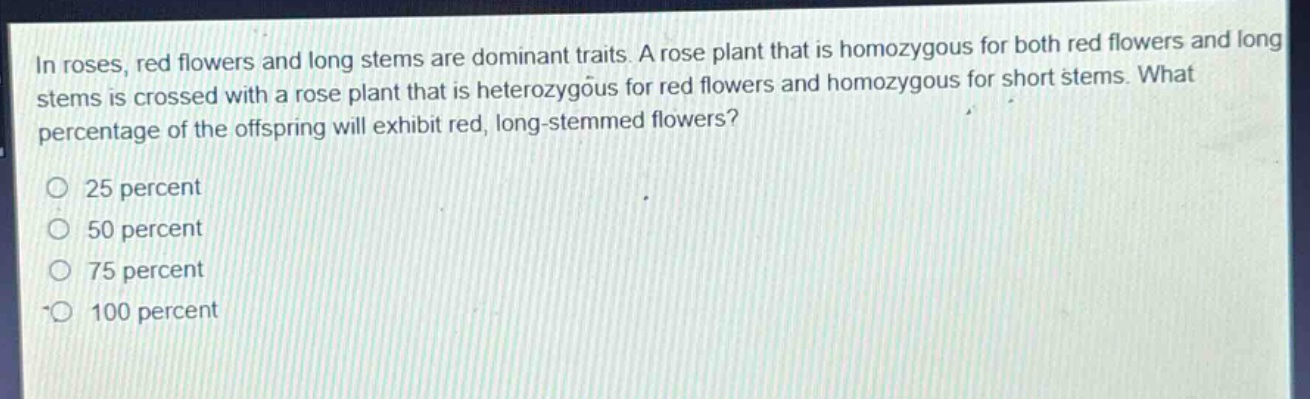
in roses, red flowers and long stems are dominant traits. a rose plant that is homozygous for both red flowers and long stems is crossed with a rose plant that is heterozygous for red flowers and homozygous for short stems. what percentage of the offspring will exhibit red, long - stemmed flowers?\n\n25 percent\n50 percent\n75 percent\n100 percent
Answer
Explanation:
Step1: Define alleles
Let R represent the allele for red flowers (dominant) and r for white flowers (recessive), and L for long - stems (dominant) and l for short - stems (recessive). The first plant is homozygous for red flowers and long stems, so its genotype is RRLL. The second plant is heterozygous for red flowers and homozygous for short stems, so its genotype is Rrll.
Step2: Determine gametes
The first plant (RRLL) can only produce RL gametes. The second plant (Rrll) can produce Rl and rl gametes.
Step3: Perform cross
When we cross RL (from the first plant) with Rl and rl (from the second plant), the possible genotypes of the offspring are RRLl and RrLl.
Step4: Analyze phenotypes
Since both RRLl and RrLl have at least one dominant allele for red flowers (R) and one dominant allele for long stems (L), all of the offspring will have red, long - stemmed flowers.
Answer:
100 percent