scientific investigations often lead to the formulation of new scientific questions. charles darwin reviewed…
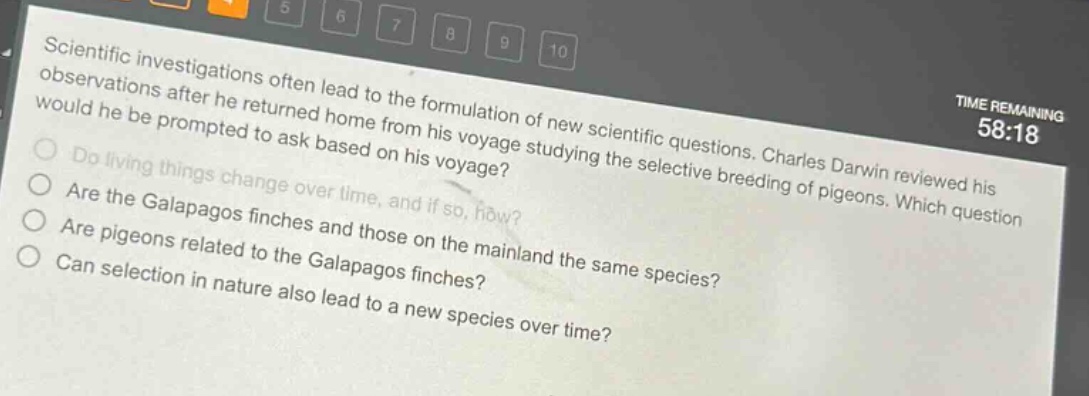
scientific investigations often lead to the formulation of new scientific questions. charles darwin reviewed his observations after he returned home from his voyage studying the selective breeding of pigeons. which question would he be prompted to ask based on his voyage? do living things change over time, and if so, how? are the galapagos finches and those on the mainland the same species? are pigeons related to the galapagos finches? can selection in nature also lead to a new species over time?
Answer
Brief Explanations:
Darwin's work focused on evolution. Questions about change in living - things over time, species - relatedness, and natural selection are central to evolutionary biology. His studies on pigeons' selective breeding related to understanding natural selection and evolution.
Answer:
All of the above questions are relevant as they pertain to evolutionary concepts which Darwin explored. But if we consider the most fundamental one related to his overall theory of evolution by natural selection, "Do living things change over time, and if so, how?" is a key question that drives the exploration of other related questions about species - relatedness and the role of selection in speciation. So the most appropriate question is "Do living things change over time, and if so, how?"