a scientist has discovered an organism that produces five offspring exactly one hour after its own birth…
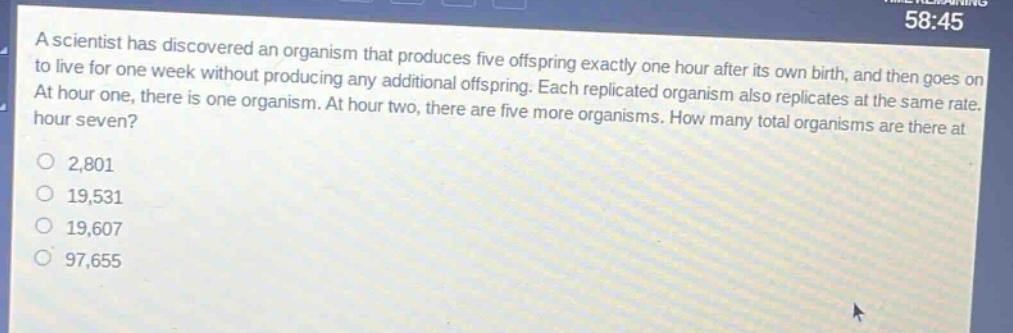
a scientist has discovered an organism that produces five offspring exactly one hour after its own birth, and then goes on to live for one week without producing any additional offspring. each replicated organism also replicates at the same rate. at hour one, there is one organism. at hour two, there are five more organisms. how many total organisms are there at hour seven?\no 2,801\no 19,531\no 19,607\no 97,655
Answer
Answer:
B. 19,531
Explanation:
Step1: Identify the sequence type
This is a geometric - sequence problem. The first - term (a_1 = 1), and the common ratio (r = 5).
Step2: Determine the number of terms
We start at hour 1 and want to find the total number of organisms at hour 7. The number of terms (n=7).
Step3: Use the sum formula for a geometric sequence
The sum formula for a geometric sequence is (S_n=\frac{a_1(r^n - 1)}{r - 1}) when (r\neq1). Here, (a_1 = 1), (r = 5), and (n = 7). [S_7=\frac{1\times(5^7-1)}{5 - 1}]
Step4: Calculate (5^7)
(5^7=5\times5\times5\times5\times5\times5\times5 = 78125).
Step5: Calculate the numerator
(5^7-1=78125 - 1=78124).
Step6: Calculate the sum
(S_7=\frac{78124}{4}=19531).